As of October 22, 2026, no electric air taxi holds an FAA type certificate, so none is yet approved to carry paying passengers. The aircraft that are flying are in testing, in demonstrations, or in the FAA's eVTOL Integration Pilot Program. That shapes the honest answer to "are they safe?": there is no passenger service record to judge yet, only a certification process, a set of FAA airworthiness criteria and a flight test history.
This guide covers where the two leading U.S. programs, Joby Aviation and Archer Aviation, stand in the FAA process, what the FAA requires of the aircraft and of the pilots, and what the companies say about speed. Everything is dated, because the situation is changing month by month.
Key Takeaways
No eVTOL has an FAA type certificate yet. Joby says it is in the fifth and final stage of the FAA process. Archer says it closed Phase 3 of a four-phase process in April 2026.
The FAA certifies these aircraft as a "special class" under 14 CFR 21.17(b), using airworthiness criteria written for each model.
Pilots must hold a type rating for each powered-lift aircraft they fly under an FAA rule that took effect January 21, 2025. Passengers need no license.
Joby lists a 200 mph top speed. Archer's early filings said 150 mph, and later filings stopped giving a figure.
Where Certification Stands (October 2026)
An eVTOL, an electric vertical takeoff and landing aircraft, is what the FAA calls a powered-lift: an aircraft that can take off and land vertically and fly like an airplane in cruise. The FAA says powered-lift aircraft need no new type certification rules. It certifies them as a special class under 14 CFR 21.17(b), a process that lets the FAA address novel features without special conditions or exemptions.
FAA type certification status of the two leading U.S. eVTOL programs
Company
What the company or FAA documents say
Date
Joby Aviation (Model JAS4-1)
Joby says it is advancing through the fifth and final stage of FAA type certification, with Type Inspection Authorization testing of conforming aircraft ongoing. It reported five aircraft flying and 12 more in production.
August 5 and September 10, 2026
Archer Aviation (Model M001, called Midnight)
Archer says it became the first eVTOL company to close Phase 3 of the FAA's four-phase type certification process, in April 2026, and is advancing Phase 4, where compliance is demonstrated through formal testing and analysis.
May 11, 2026
Neither company has announced a date by which it expects the certificate. The FAA's own rulemaking said in November 2024 that there were then no type-certificated powered-lift in civil operations, and no eVTOL has changed that since, as far as the companies' latest statements show.
What the Pilot Program Is, and Is Not
On March 9, 2026, the Department of Transportation and the FAA announced eight selected projects in the eVTOL Integration Pilot Program (eIPP), spanning 26 states. The FAA said the American public would start to see operations by summer 2026, and that data from the projects would be used to develop regulations to enable the technology at scale. The concepts include urban air taxi services, regional passenger transportation, cargo, emergency medical response, autonomous flight and offshore energy transportation.
Joby's first eIPP flights in Texas ran from September 10 to 14, 2026, at Perot Field Fort Worth Alliance, with flights into Dallas-Fort Worth International's controlled airspace and to Arlington and Plano. Joby says it has not given a commercial launch date, and that the flights are meant to generate operational data. The pilot program is not a substitute for a type certificate.
What the FAA Requires of the Aircraft
The FAA published final special class airworthiness criteria for the Joby Model JAS4-1 on March 8, 2024 and for the Archer Model M001 on May 24, 2024. They describe the aircraft the FAA is evaluating:
Aircraft described in the FAA final airworthiness criteria
Model
Maximum takeoff weight
Occupants
Propulsion
Joby Aero JAS4-1
4,800 lb
Pilot and four passengers
Six tilting electric engines with five-blade propellers, a conventional wing and V-tail, composite structure
Archer M001 (Midnight)
6,500 lb
Pilot and four passengers
Twelve electric engines: six tilting with five-blade propellers on the wing, and six fixed, two-blade, for vertical and transitional flight; high wing, V-tail, fixed tricycle landing gear
Each set of criteria draws on existing standards for airplanes, engines and propellers (parts 23, 33 and 35) and adds requirements for the unique features of a powered-lift. One public comment asked the FAA to match a European requirement that a single failure must not have a catastrophic effect on the aircraft. The FAA declined to include that European "Category Enhanced" requirement, but said it tightened its structural inspection requirement so that damage can be reliably detected before it causes a structural failure. Those details show the safety question is being worked out in a technical process, not decided by an announcement.
The Test Flight Record
Prototype flight testing has had at least one serious accident. On February 16, 2022, an uncrewed Joby prototype crashed near Monterey, California, and burned. The NTSB's preliminary report cited an unspecified component failure. We found no comparable data on passenger operations, because none exist yet, so any claim that air taxis are safer or less safe than helicopters is not yet supported by evidence.
Do You Need a License to Fly One?
Yes, to be the pilot. No, to ride as a passenger. In a final rule published November 21, 2024 and effective January 21, 2025, the FAA set the training and certification requirements for powered-lift pilots. The rule:
Requires every powered-lift pilot in command to hold a type rating for the specific aircraft. The FAA did not create classes within the category, because each powered-lift has different configurations and controls.
Creates a new 14 CFR Part 194, Special Federal Aviation Regulation No. 120, which sets alternative paths for certifying the first group of powered-lift pilots and instructors. The SFAR lasts ten years.
Offers three options for training in aircraft with a single flight control and a single pilot station: a single control accessible to both student and instructor, expanded simulator use, and deviation authority for future technology.
Adds powered-lift pilot qualification requirements for commuter and on-demand operations under Part 135.
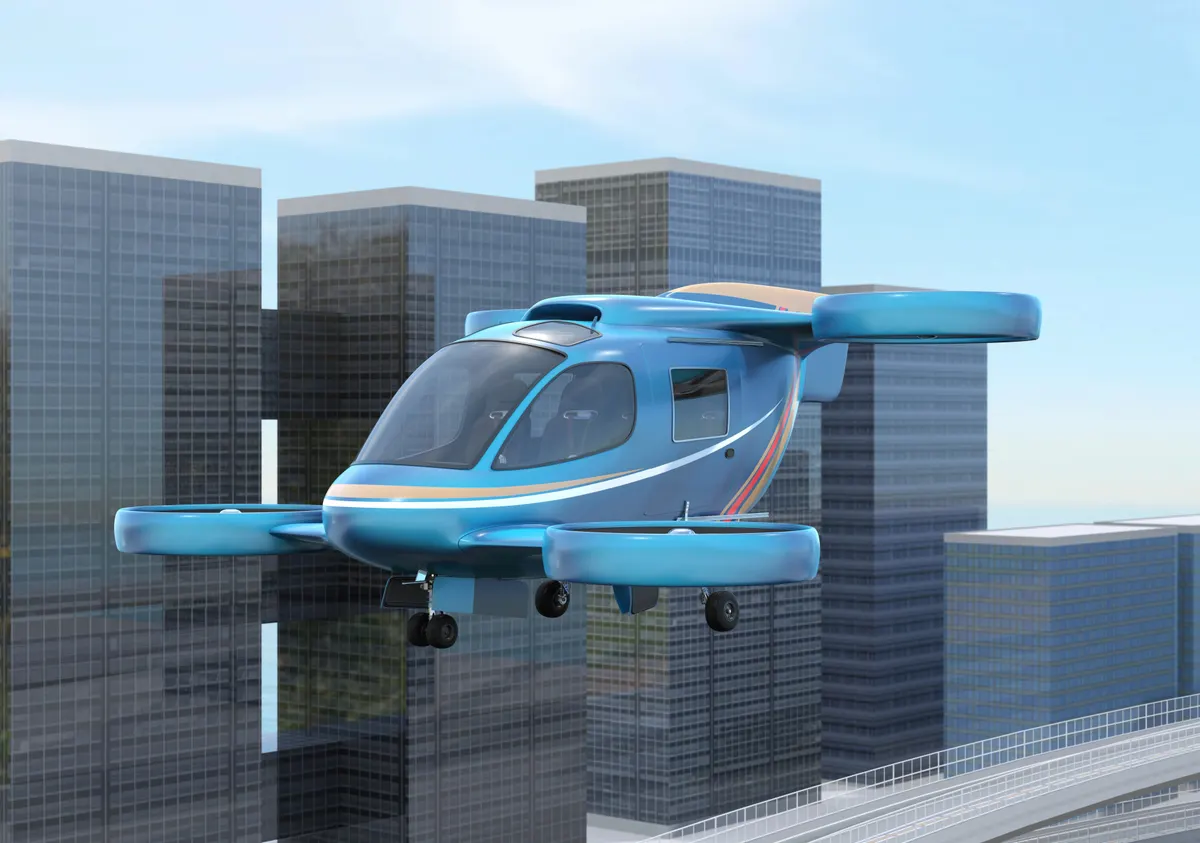
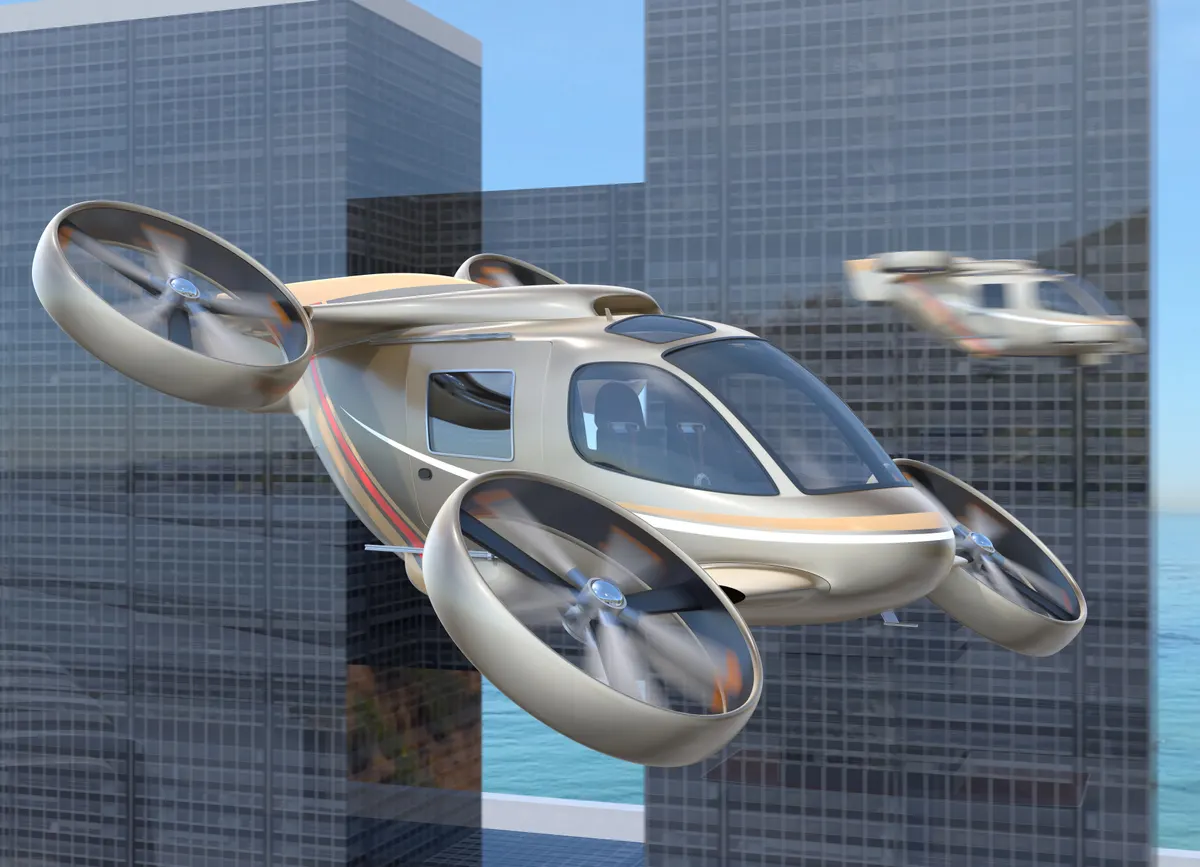
A computer-generated illustration of a generic air taxi. It is not a Joby or Archer aircraft.
How Fast Do Electric Air Taxis Fly?
The figures are company claims, and they have shifted.
Joby lists a 200 mph top speed on its website.
Archer described Midnight in its annual report for 2022 as designed to carry four passengers and a pilot up to 100 miles at speeds up to 150 mph, optimized for back-to-back short trips of around 20 miles with about 10 minutes of charging between them. Its later annual reports, for 2023, 2024 and 2025, drop the speed and range numbers and keep the passenger count and the 20-mile trip focus.
Electric motors are one of several ways to power an aircraft. For the others, see our guide to the types of aircraft engines.
Frequently Asked Questions
Are electric air taxis safe?
It is too early to say from passenger operations, because no eVTOL has an FAA type certificate and none is carrying paying passengers. The FAA is certifying them as a special class aircraft with airworthiness criteria written for each model, and the manufacturers are still in flight testing.
Has the FAA certified any electric air taxi?
Not as of October 22, 2026. Joby says it is in the fifth and final stage of FAA type certification. Archer says it closed Phase 3 of the four-phase process in April 2026.
How fast can electric air taxis go?
Joby lists a 200 mph top speed. Archer's 2022 annual report said Midnight could fly up to 100 miles at up to 150 mph, though its later reports no longer give those figures and describe the aircraft as optimized for trips of around 20 miles.
Do you need a license to fly an air taxi?
A pilot does. Under the FAA's powered-lift rule effective January 21, 2025, the pilot in command must hold a type rating for the aircraft. Passengers need no license.
What is the eVTOL Integration Pilot Program?
A DOT and FAA program announced March 9, 2026 with eight selected projects across 26 states. It lets companies, states and local governments test real operations before certification, and the FAA says it will use the data to develop regulations for operations at scale.
How many people can an electric air taxi carry?
The FAA's criteria for both the Joby JAS4-1 and the Archer M001 describe an aircraft that carries a pilot and four passengers.
Keep PilotPassion in your Google results
Add us as a preferred source and we are more likely to appear in your Top Stories.