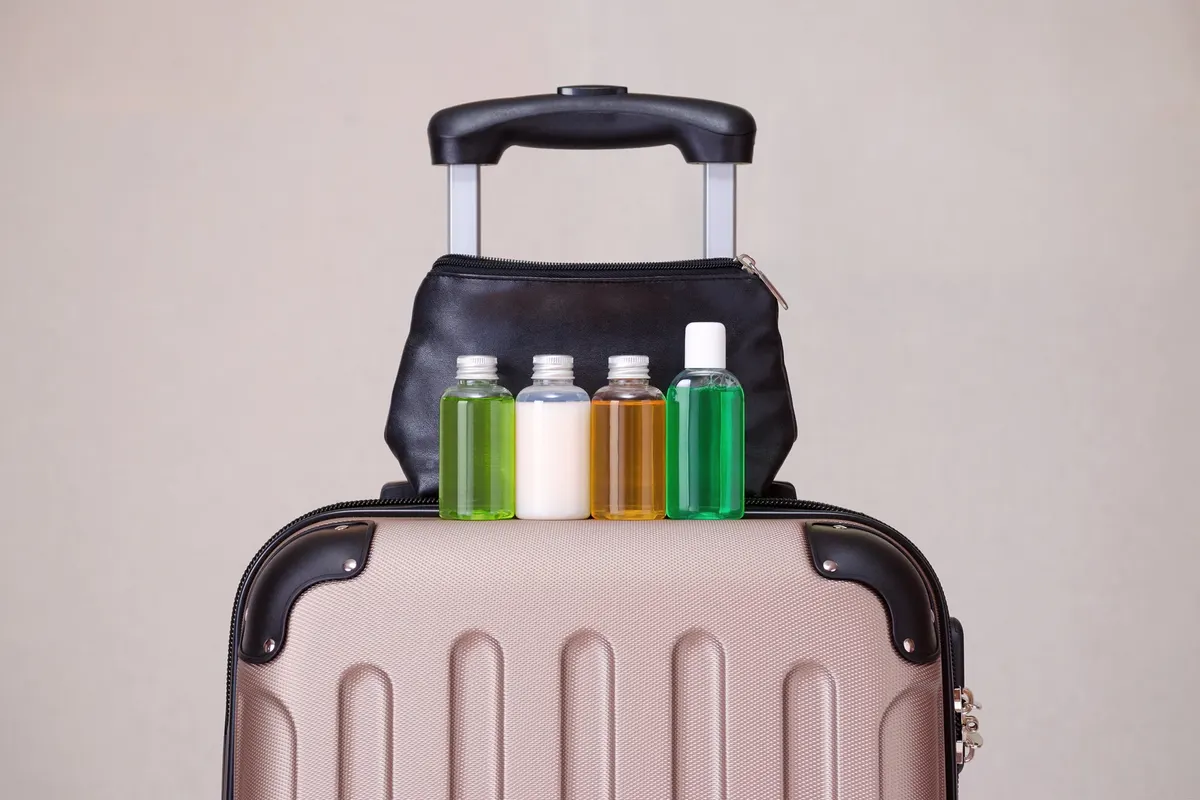
In a U.S. carry-on bag, every liquid, aerosol, gel, cream and paste must be in a container of 3.4 ounces (100 milliliters) or less, and all of those containers must fit in one quart-sized bag. Anything in a bigger container goes in your checked bag.
TSA calls it the 3-1-1 rule. The exceptions that matter most are medications, baby formula and breast milk, and a short list of other items. This guide covers the rule, every exception TSA publishes, the separate federal limits for checked bags and alcohol, why the rule exists and where it's headed.
The TSA 3-1-1 liquids ruleOriginal diagram, based on TSA guidance
The 3-1-1 rule: 3.4 ounce containers, one quart-size bag, one bag per traveler. Original diagram for PilotPassion.
TSA's liquids rule page says you may bring a quart-sized bag of liquids, aerosols, gels, creams and pastes through the checkpoint in your carry-on, limited to travel-sized containers of 3.4 ounces (100 milliliters) or less per item. Putting the items in the small bag and keeping it apart from the rest of your carry-on makes screening quicker. Any liquid, aerosol, gel, cream or paste that alarms during screening needs extra screening.
The size limit is on the container. TSA words it as 3.4 ounces or less "per item" and tells travelers to pack anything in a bigger container in checked baggage.
What Counts as a Liquid, Aerosol, Gel, Cream or Paste
Liquids: water and other drinks, shampoo, perfume, mouthwash.
If you can pour, spray, squeeze or spread it, treat it as covered. When in doubt, put it in checked baggage.
Exemptions: What You Can Bring in Larger Amounts
Medications. TSA allows larger amounts of medically necessary liquids, gels and aerosols in reasonable quantities for your trip. You must declare them to the officer at the checkpoint for inspection.
Baby formula, breast milk, toddler drinks and baby food. These are allowed in carry-on bags in amounts above 3.4 ounces (100 milliliters) and don't need to fit in the quart-sized bag. TSA treats them as medically necessary liquids, and the same goes for ice packs, freezer packs and gel packs used to cool them, whether or not there's breast milk in the bag. A child doesn't need to travel with you for you to carry them. Tell the officer at the start of screening, and take the items out of your carry-on for separate screening. Officers may test the liquids, and TSA recommends clear, translucent bottles over plastic bags or pouches, which a bottle scanner may not handle. TSA says its X-ray machines do not adversely affect food or medicine, and you can ask that the items not be X-rayed or opened, which brings extra screening for you.
Frozen items and gel packs. Frozen liquid items are allowed if they're frozen solid when presented for screening. If they are partially melted, slushy or have liquid at the bottom, they must meet the 3-1-1 rule. Medically necessary gel ice packs in reasonable quantities are allowed in any state, and you should tell the officer.
Duty-free liquids on international flights into the United States. You may carry duty-free liquids over 3.4 ounces when you bought them internationally and are connecting to a flight to the United States, they are sealed in a transparent, tamper-evident bag by the retailer, the bag shows no sign of tampering, and you hold the original receipt for a purchase made within 48 hours. The items must still be screened and cleared, and TSA recommends packing them in checked baggage anyway.
Checked Bags, Aerosols and Alcohol: The Federal Limits
The 3-1-1 rule is about carry-ons. Checked bags and carry-ons are also covered by federal hazardous materials rules for passengers, 49 CFR 175.10:
Toiletries and medicine, including aerosols: each container may hold no more than 0.5 kg (18 ounces) by mass or 500 ml (17 fluid ounces) by volume, and the total per person may not exceed 2 kg (70 ounces) by mass or 2 L (68 fluid ounces) by volume. Release devices on aerosols must be protected by a cap.
Alcohol at 24% or less by volume: no limit in the federal exception.
Alcohol over 24% and up to 70%: unopened retail packaging, no container over 5 liters (1.3 gallons), and no more than 5 liters per person in total.
Alcohol over 70%: not covered by the exception.
TSA adds that mini bottles of alcohol in a carry-on must fit comfortably in the single quart-sized bag, and that FAA rules prohibit drinking your own alcohol on board unless a flight attendant served it. Check your airline before carrying any alcohol on board.
Common Container Sizes and Whether They Pass
Carry-on container sizes against the 100 ml limit
Container
Capacity
Allowed in carry-on?
Travel-size toothpaste or lotion, 3 oz
89 ml
Yes, in the quart bag
The TSA limit, 3.4 oz
101 ml
Yes, in the quart bag
Small bottle of contact lens solution or sunscreen, 4 oz
118 ml
No, check it or buy after screening
Standard water or soda bottle, 16.9 oz (500 ml)
500 ml
No, check it or buy after screening
Quart bottle, 32 oz
946 ml
No, check it or buy after screening
One US fluid ounce is 29.5735 milliliters, so 3.4 ounces is 100.55 milliliters. TSA states the limit both ways, 3.4 ounces or 100 milliliters, and a container labeled 100 ml or 3.4 oz meets it. A bottle marked 4 ounces, which is about 118 milliliters, does not. The amounts here are example sizes, not product listings.
Why the Rule Exists
TSA's timeline gives the history. In August 2006, terrorists plotted to detonate liquid explosives carried onboard at least 10 airliners traveling from the UK to the United States and Canada, and British police foiled the plot. TSA responded by banning all liquids, gels and aerosols from passenger carry-ons. In September 2006, a month after the ban began, TSA amended the rule to allow liquids, gels and aerosols in containers of 3.4 ounces or less, which became the 3-1-1 rule.
The rule has had one big change since. In March 2020, TSA allowed one liquid hand sanitizer container of up to 12 ounces per passenger in carry-on bags because of COVID-19. After the federal public health emergency ended, TSA returned on May 12, 2023 to the 3-1-1 rule for hand sanitizer.
Is the Rule Going Away?
TSA is rolling out CT (computed tomography) scanners at checkpoints. The technology makes 3-D images of a bag that officers can rotate, and TSA says it creates such a clear picture that computers can automatically detect explosives, including liquids. TSA's CT page says that in the future the goal is to keep laptops and 3-1-1 liquids inside the bag during screening, and that under current procedures for this technology laptops may stay in the bag. It does not say the size limit has gone. Until TSA announces otherwise, the 3.4 ounce limit and the quart bag still apply.
Other Countries
This page covers the rule TSA applies at U.S. checkpoints. Other countries and airports set their own limits and may use different scanners, and the airline may have separate carry-on size rules. Check the security page of your departure airport before you travel, especially on connecting international trips.
Frequently Asked Questions
How many ounces of liquid can you take on a plane in a carry-on?
Each container can hold up to 3.4 ounces (100 milliliters), and all of them must fit in one quart-sized bag, according to TSA.
Is the TSA limit 3 oz or 3.4 oz?
TSA's current rule states 3.4 ounces, which equals 100 milliliters. Some older signs and articles say 3 ounces.
Can you bring a full water bottle through airport security?
Not in a bottle larger than 3.4 ounces. Most travelers bring it empty and fill it after screening, or buy a drink after the checkpoint.
Can you bring more than 3.4 ounces of baby formula or breast milk?
Yes. TSA allows formula, breast milk, toddler drinks and baby food over 3.4 ounces in carry-on bags. Tell the officer at the start of screening and remove them for separate screening. A child does not need to be traveling with you.
Can you take liquid medication on a plane?
Yes. TSA allows medically necessary liquids, gels and aerosols in reasonable quantities for your trip in larger amounts than 3.4 ounces. You must declare them to the officer at the checkpoint.
Can you take liquids in checked baggage?
Yes. TSA tells travelers to pack containers larger than 3.4 ounces in checked bags. Federal rules limit each container of toiletries or medicine to 0.5 kg or 500 ml, and the total to 2 kg or 2 L per person (49 CFR 175.10).
How much alcohol can you pack in checked baggage?
Alcohol at 24% by volume or less has no limit under the federal exception. Alcohol over 24% and up to 70% must be in unopened retail packaging and is limited to 5 liters per person. Alcohol over 70% is not covered by the exception.
Can you bring a frozen gel pack or ice pack?
Yes if it is frozen solid when presented for screening. A partly melted pack must meet 3-1-1, but medically necessary gel packs in reasonable quantities are allowed in any state.
Did the hand sanitizer exception end?
Yes. TSA allowed one container of up to 12 ounces per passenger from March 2020 and returned to the 3-1-1 rule for hand sanitizer on May 12, 2023.
Why does TSA limit liquids?
After British police foiled a plot in August 2006 to detonate liquid explosives on at least 10 airliners, TSA banned liquids, then allowed 3.4 ounce containers in a quart bag from September 2006.
Keep PilotPassion in your Google results
Add us as a preferred source and we are more likely to appear in your Top Stories.