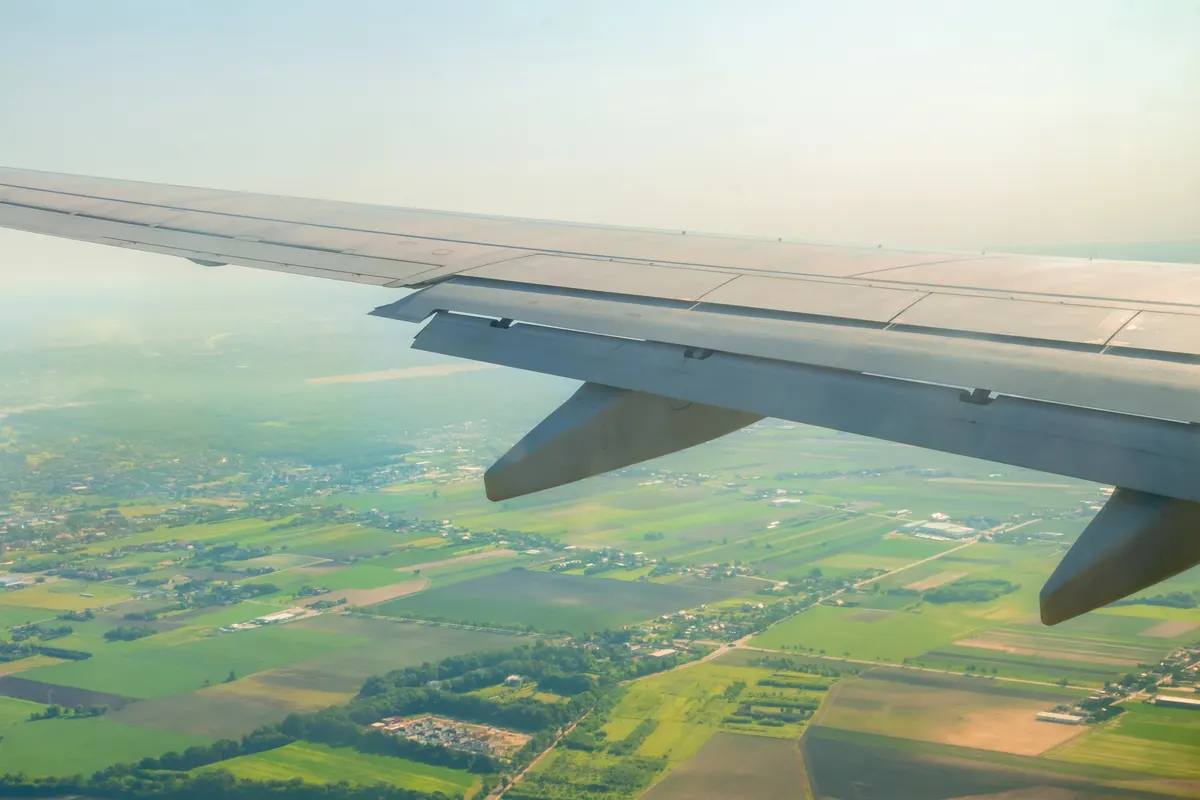
Trailing edge flaps are hinged or sliding surfaces on the back of a wing, and some aircraft also have leading edge flaps. When the pilot extends them, they raise both lift and drag, which lets an airplane fly slower on approach and land in a shorter distance. The FAA's handbooks name four common types: plain, split, slotted and Fowler. Slotted flaps are the most popular on aircraft today, and Fowler flaps give the largest gain in lift.
This guide explains how each type works, with simple diagrams, then covers what airliners add: leading edge flaps, slats and spoilers. It ends with how pilots use flaps for takeoff, landing and go-arounds, and what the flap speed markings mean.
Key Takeaways
Flaps work mainly by increasing the camber of the wing, and some designs also add wing area. They don't raise the stall angle of attack.
Flap deflection up to about 15 degrees mostly adds lift. Beyond that it adds a lot of drag.
Pilots extend flaps in steps in the landing pattern, and retract them in steps after takeoff and in a go-around.
Slats and leading edge flaps do the same job at the front of the wing. Spoilers do the opposite: they dump lift.
The white arc on the airspeed indicator shows the flap operating range, ending at VFE, the maximum speed with flaps extended.
What Flaps Do
The FAA's Pilot's Handbook of Aeronautical Knowledge calls flaps the most common high-lift devices on aircraft. They attach to the trailing edge of the wing and increase both lift and induced drag at any given angle of attack. That lets designers compromise between a high cruising speed and a low landing speed: the flaps are extended when needed and retracted into the wing structure when not.
The Airplane Flying Handbook explains how. Flaps work primarily by changing the camber of the airfoil, which increases the wing's lift coefficient, and with some designs the wing area as well. Flap deflection doesn't increase the critical (stall) angle of attack, and in some cases it decreases it. Unlike ailerons, which deflect in opposite directions and roll the airplane, flaps move symmetrically, so they produce no rolling moment. They do change the pitching moment: depending on the flap type, wing position, downwash and tail location, an airplane may pitch nose-up, nose-down or barely at all, so the behavior depends on the particular airplane.
The handbook gives a rule of thumb. Flap deflection up to 15 degrees primarily produces lift with minimal increases in drag. Beyond 15 degrees, drag rises sharply, and in most high-wing airplanes the changed downwash on the tail produces a significant nose-up pitching moment. Drag from flaps is parasite drag, so it grows with the square of the speed.
The Four Common Types of Flaps
The diagrams are simplified schematics, not to scale. The dashed outline shows where the flap sits when retracted.
Plain flap. The simplest type. A hinged section of the wing that swings down and increases the camber.Split flap. Only the lower surface near the trailing edge deflects, leaving the upper surface undisturbed.Slotted flap. A gap, the slot, lets high-energy air from below the wing flow over the flap's upper surface.Fowler flap. A type of slotted flap that slides aft on tracks as it deflects, adding wing area as well as camber.
The four flap types as the FAA's Pilot's Handbook of Aeronautical Knowledge describes them
Type
How it works
Effect
Plain flap
The simplest of the four. It increases the airfoil camber.
A significant increase in the lift coefficient at a given angle of attack, but a large increase in drag, and the center of pressure moves aft, causing a nose-down pitching moment.
Split flap
Deflected from the lower surface of the airfoil only.
A slightly greater increase in lift than the plain flap, with more drag from the turbulent air behind the airfoil.
Slotted flap
When lowered, a duct forms between the flap well in the wing and the leading edge of the flap, carrying high-energy air from the lower surface to the upper surface.
The slotted flap increases the lift coefficient significantly more than plain or split flaps, because the energized boundary layer delays flow separation.
Fowler flap
A type of slotted flap that slides backward on tracks instead of rotating down on a hinge.
In the first part of its travel it adds a great deal of lift for very little drag, because it increases both area and camber. In the last part it adds drag with little extra lift.
Plain and split flaps
The pilot handbook notes that when fully extended, both plain and split flaps produce high drag with little additional lift. The Airplane Flying Handbook (AFH) adds that partially deflected plain flaps have the advantage on takeoff, because airflow stays attached to the flap and they don't add much drag at small deflections, while split flaps are more useful for landing because they add significant drag even at small deflections. The FAA's maintenance handbook describes a split flap as usually just a braced flat plate hinged along its leading edge and housed under the trailing edge of the wing.
Slotted flaps
Variations of the slotted flap are used on small aircraft and large ones. On small aircraft the hinge is located below the lower surface of the flap. Large aircraft often use double and even triple slotted flaps, which allow the maximum increase in drag without the airflow over the flaps separating and destroying the lift they produce. The AFH says the slotted flap's higher lift-to-drag ratio gives better takeoff and climb performance, and that its small deflections add more drag than a plain flap but less than a split flap, which is why it can be used for takeoff.
Fowler flaps
The AFH says the Fowler flap deflects down and aft to increase the wing area, can be multi-slotted, and gives the maximum lift coefficient of the trailing-edge systems. It's most commonly used on larger airplanes because of its structural complexity and the difficulty of sealing its slots. The maintenance handbook adds that the sliding motion can be accomplished with a worm drive and flap tracks.
Where the two FAA handbooks differ
The two pilot handbooks don't rank the types in exactly the same way. The PHAK says slotted flaps increase the lift coefficient significantly more than plain or split flaps. The AFH says the slotted flap has greater lift than the hinge flap but less than the split flap, though it has a higher lift-drag ratio. The AFH identifies Fowler flaps as giving the maximum lift coefficient of the trailing-edge systems, and the PHAK describes the Fowler's added area and camber. How much lift a flap adds depends on its size, type and the aircraft it's fitted to, so the airplane's own manual is the guide.
Airliner Flaps: Triple-Slotted Flaps, Slats and Krueger Flaps
The FAA's maintenance handbook describes what large aircraft add. Flaps are usually inboard on the wing's trailing edge next to the fuselage, and typically they can extend up to 45 to 50 degrees, with the amount selected from the flight deck. On light aircraft they're usually aluminum. Heavy and high-performance aircraft may have aluminum flaps too, but composite structures are common.
A triple-slotted flap is the enhanced Fowler. It's made of a fore flap, a mid flap and an aft flap, and when deployed each section slides aft on tracks as it lowers. The sections separate and leave an open slot between the wing and the fore flap and between each section, so air from under the wing flows through the slots, which the handbook says enhances laminar flow on the upper surfaces. The greater camber and effective wing area increase overall lift.
Heavy aircraft often add leading edge flaps, used together with the trailing edge flaps. When stowed, they retract into the leading edge. The handbook says that on the designs it describes, activating the trailing edge flaps automatically deploys the leading edge flaps, which drive out of the leading edge and downward to extend the camber. One version is the Krueger flap, recognizable by its flat mid-section. The handbook shows one on a Boeing 737.
Slats are the other leading edge device. They can be operated independently of the flaps, with their own switch in the flight deck. A slat extends out of the leading edge, increasing camber and lift, and most often leaves a slot between its trailing edge and the wing's leading edge when fully deployed. The handbook says this increases the angle of attack at which the wing keeps its airflow, so the aircraft can fly slower with a reduced stall speed and still maintain control.
Secondary control surfaces on larger aircraft (FAA Aviation Maintenance Technician Handbook, Figure 1-61)
Surface
Where
What it does
Flaps
Inboard trailing edge of the wings
Extend the camber of the wing for greater lift and slower flight, and allow control at low speeds for short-field takeoffs and landings.
Leading edge flap
Inboard leading edge of the wing
Extends the camber of the wing for greater lift and slower flight, as trailing edge flaps do.
Slat
Mid to outboard leading edge of the wing
Extends the camber of the wing for greater lift and slower flight.
Slot
Outer leading edge, forward of the ailerons
Directs air over the upper surface of the wing at a high angle of attack, which lowers stall speed and gives control in slow flight.
Spoiler
Upper surface and/or trailing edge of the wing
Decreases lift, and can augment the ailerons.
Leading Edge Devices on Smaller Airplanes
High-lift devices can also be fitted to the leading edge of the wing. The PHAK lists fixed slots, movable slats, leading edge flaps and cuffs as the most common types, and each one does a slightly different job.
Fixed slots direct airflow to the upper wing surface and delay airflow separation at higher angles of attack. The slot doesn't increase the camber, but it allows a higher maximum lift coefficient because the stall is delayed until the wing reaches a greater angle of attack.
Movable slats are leading edge segments that move on tracks. At low angles of attack the high pressure at the leading edge holds each slat flush against the wing. As the angle of attack rises, the high-pressure area moves aft below the wing and the slats move forward. Some slats are pilot operated and can be deployed at any angle of attack. An open slat lets air from below the wing flow over the upper surface and delays separation.
Leading edge flaps increase both maximum lift coefficient and camber, are frequently used with trailing edge flaps, and can reduce the nose-down pitching moment the latter produce.
Leading edge cuffs extend the leading edge down and forward in most cases, so the airflow attaches better to the upper surface at high angles of attack and the stall speed is lowered. They're fixed, so they cost some maximum cruise speed, although the PHAK says recent design advances have reduced the penalty.
Spoilers and Speed Brakes: Flaps in Reverse
A spoiler does the opposite of a flap. It's stowed flush with the wing's upper surface and, when raised into the airstream, it disrupts the smooth airflow and reduces lift. The PHAK says spoilers are found on some fixed-wing aircraft and describes the uses. On gliders they're most often used to control the rate of descent for accurate landings. On other aircraft they're often used for roll control, which eliminates adverse yaw: raising the spoiler on the right wing destroys some lift and adds drag on that side, so the right wing drops. Deployed on both wings at once, they let the aircraft descend without gaining speed, and after landing they transfer weight to the wheels and improve braking.
The maintenance handbook adds that at low speeds on many large aircraft the spoilers are rigged to move when the ailerons move, on the wing where the aileron goes up, and that as speed rises the interconnect disengages. Some aircraft also have flaperons, which are ailerons that can also act as flaps.
How Pilots Use Flaps
The AFH says it's impossible to cover every airplane and flap combination, so pilots should follow the FAA-approved Airplane Flight Manual or Pilot's Operating Handbook (AFM/POH). Some are specific about how flaps are used, and others leave it to the pilot's discretion. These are the handbook's general points by phase of flight.
Using flaps by phase of flight (FAA Airplane Flying Handbook, Chapters 6, 9 and 12)
Phase
What the handbook says
Short-field takeoff
If the manufacturer recommends flaps, extend them the proper amount before the takeoff roll so the pilot can concentrate on technique. They stay in the takeoff position until the airplane is clear of obstacles and has established VY, then it's usually advisable to raise them in increments to avoid a sudden loss of lift and settling.
Normal approach
Extend flaps in increments on downwind, base and final, with smaller changes of pitch and power, and re-trim after each change. Full flaps aren't recommended until the final approach is established.
Gusty crosswind
To maintain control in turbulent air with a gusty crosswind, use partial flaps. With less than full flaps the airplane is in a higher pitch attitude.
Short-field landing
The procedures generally involve a final approach and the use of full flaps at an appropriate point. For many general aviation airplanes that means flying a stabilized final with the setting that precedes full flaps, then extending full flaps when the field is made.
Soft-field landing
Flaps help touch down at minimum speed and are recommended whenever practical. In low-wing airplanes the flaps may suffer damage from mud, stones or slush thrown up by the wheels.
Landing roll
It's generally inadvisable to retract the flaps during the after-landing roll, because full control of the airplane matters more. The handbook notes accidents in which the pilot retracted the gear instead of the flaps while the airplane was still rolling.
Go-around
Retract the flaps at least partially before the landing gear unless the AFM/POH says otherwise, in small increments so the airplane can accelerate as they come up. A sudden and complete retraction could cause a loss of lift and settling.
Too low or too short
The pilot shouldn't retract flaps to stretch the glide or correct an undershoot, because that causes a sudden decrease in lift and a faster sink rate.
On approach, the AFH lists four advantages of flap extension: greater lift, which permits lower approach and landing speeds; greater drag, which permits a steeper descent angle; increased forward visibility by allowing a lower pitch; and a shorter landing roll. It describes the pitch effect: increased camber raises lift mainly on the rear of the wing, which produces a nose-down pitching moment, and initial deflection tends to make the airplane balloon, while the nose-down moment offsets it. The pitch attitude of a full-flap approach is considerably lower than a no-flap approach, so the nose has to travel through a greater pitch change in the flare. On base leg the target airspeed is approximately 1.4 times VSO (the stall speed in the landing configuration), and on final the pilot uses the manufacturer's recommended speed, with 1.3 VSO as the AFH's fallback when there's no recommendation. Our guide to how fast airplanes fly covers typical speeds.
For a go-around, the AFH gives two reasons to take the flaps up first: on most airplanes full flaps produce more drag than the gear, and if the airplane inadvertently touches down as the go-around begins, it's better to have the gear down and locked.
Flap Speeds: The White Arc and VFE
On the airspeed indicator, the PHAK says the white arc is commonly called the flap operating range. Its lower limit, VS0, is the stalling speed or minimum steady flight speed in the landing configuration, which in small aircraft is the power-off stall speed at maximum landing weight with the gear and flaps down. Its upper limit, VFE, is the maximum speed with the flaps extended. Approaches and landings are usually flown at speeds within the white arc. The green arc, the normal operating range, starts at VS1.
Can a Plane Use Flaps in a Turn?
There's no single FAA rule for every airplane, so the flight manual or POH is the place to look for flap limits and procedures. In a coordinated level turn, more bank means a higher load factor on the wing, and the AFH says that as load factor rises, so does stalling speed. Its example: an airplane that stalls in level flight at 50 knots will stall at 60 knots in a 45 degree steep turn while holding altitude, and at 70 knots at 60 degrees of bank. Stalling speed rises with the square root of the load factor. This is general information, not instruction for any particular aircraft, so follow your flight manual and your instructor.
Plain, split, slotted and Fowler flaps, according to the FAA's Pilot's Handbook of Aeronautical Knowledge and Airplane Flying Handbook.
What's the most common type of flap?
The slotted flap, which the FAA calls the most popular flap on aircraft today. Variations are used on small and large aircraft.
What's a Fowler flap?
A type of slotted flap that slides backward on tracks while it deflects down, increasing both wing area and camber. The FAA says it gives the maximum lift coefficient of the trailing-edge systems and is used mostly on larger airplanes.
What do flaps do on an airplane?
They increase lift and drag. That permits lower approach and landing speeds, a steeper descent angle, better forward visibility from a lower pitch and a shorter landing roll, according to the Airplane Flying Handbook.
What's the difference between flaps and slats?
Trailing edge flaps are on the back of the wing, and slats are on the leading edge. Both extend the camber of the wing for greater lift and slower flight. The FAA says slats can be operated independently of the flaps, and most leave a slot that lets the wing keep its airflow at a higher angle of attack.
What's a Krueger flap?
A leading edge flap that drives out of the leading edge and downward to extend the camber, recognizable by its flat mid-section. The FAA's maintenance handbook shows one on a Boeing 737.
Do flaps reduce stall speed?
Flaps increase the wing's lift coefficient, so the airplane can fly slower for the same lift. The lower end of the white arc, VS0, is the stall speed in the landing configuration with the gear and flaps down. Flaps don't raise the critical angle of attack.
How many degrees of flaps should you use?
The airplane's flight manual or pilot's operating handbook sets it. As a general guide, the FAA says deflection up to 15 degrees mostly adds lift, and beyond 15 degrees drag increases sharply. The maintenance handbook says flaps on larger aircraft can typically extend up to 45 to 50 degrees.
What does VFE mean?
The maximum speed with the flaps extended. It's the upper limit of the white arc on the airspeed indicator.
Should you retract flaps or landing gear first in a go-around?
Unless the flight manual says otherwise, the Airplane Flying Handbook recommends retracting the flaps at least partially before the landing gear, because full flaps usually create more drag than the gear and the gear should be down if the airplane touches down.
What's the difference between flaps and spoilers?
Flaps increase lift and drag. Spoilers are raised into the airstream to disrupt the airflow and reduce lift, and on both wings at once they work as speed brakes. On some aircraft spoilers also help with roll control.
What's the difference between flaps and ailerons?
Ailerons deflect in opposite directions and roll the airplane. Flaps deflect symmetrically, producing no rolling moment but increasing lift and drag. Some aircraft have flaperons, ailerons that can also act as flaps.
Keep PilotPassion in your Google results
Add us as a preferred source and we are more likely to appear in your Top Stories.