A 17-person expedition went to a remote Pacific atoll to find out whether a shape in a lagoon was the Lockheed Electra that Amelia Earhart and Fred Noonan flew into history. On October 18, 2026, Purdue reported that the team found no conclusive evidence of the plane. The object, called the Taraia Object, was most likely a collection of large trees.
Searchers have thought they had her plane before. The best-known sonar image, in 2024, was withdrawn when a second survey showed a natural rock formation. So this page does two jobs: it reports on the search as it stands, and it sorts the established facts about the flight from the claims that remain disputed.
It covers the 2026 expedition and its result, the last hours of the flight on July 2, 1937, the navigator who flew with her, the evidence for and against each major theory, and what would count as proof.
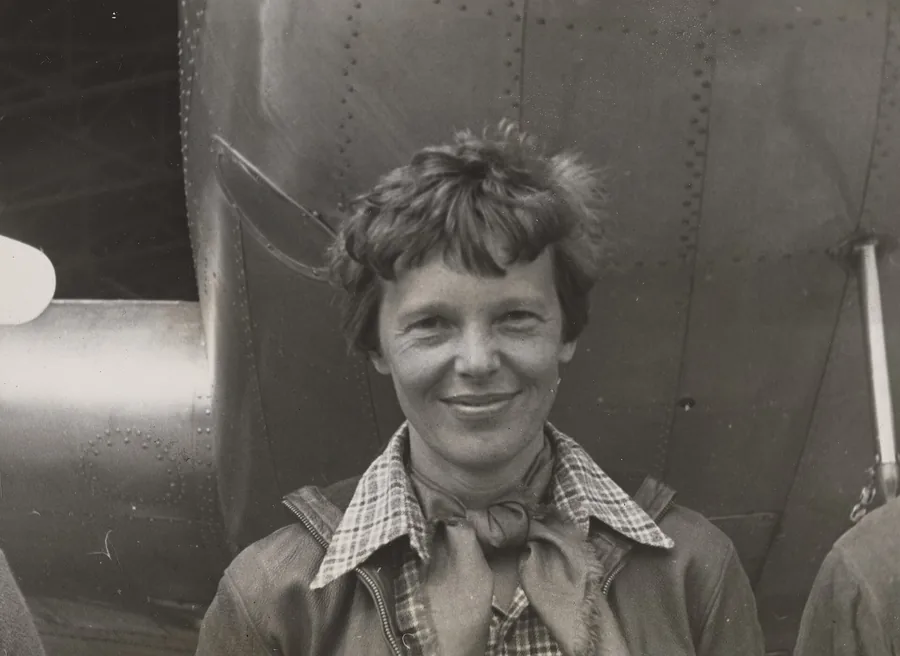
Amelia Earhart under the nose of her Lockheed Model 10-E Electra, probably before the 1937 world flight attempt. Photo: Underwood & Underwood, National Air and Space Museum collection, via Wikimedia Commons. Public domain.
Key Insights
An expedition from the Archaeological Legacy Institute and Purdue University surveyed the Taraia Object at Nikumaroro in October 2026. On October 18 it reported no conclusive evidence that the object is Earhart's plane. It was most likely a collection of large trees.
The team still backs the castaway hypothesis and Purdue says the search will continue. No second expedition has been announced.
The official conclusion since 1937 is that the Electra ran out of fuel and crashed in the ocean near Howland Island. No wreckage has ever been confirmed.
The leading alternative is that Earhart and her navigator, Fred Noonan, landed on Nikumaroro and died as castaways. The evidence is circumstantial, and the best physical clue, a set of bones, has been lost since the 1940s.
The Japanese capture theory has no physical evidence behind it. A 2017 photo said to prove it turned out to come from a 1935 book.
Noonan was one of the best-regarded long-range navigators of his day. Any explanation of the flight has to account for his navigation as well as her flying.
The 2026 expedition: what it found
Updated October 20, 2026. This section reflects Purdue's release of October 18 and reporting to October 19.
The Archaeological Legacy Institute (ALI), Purdue University and the Purdue Research Foundation ran the expedition. It went to Nikumaroro to test whether an anomaly in the lagoon, the Taraia Object, was the remains of Earhart's Electra. On October 18, 2026 (Monday, October 19 local time), Purdue said the team found no conclusive evidence that wreckage from the plane lies in the lagoon.
The 17-person team included filmmakers, a medic, maritime and terrestrial archaeologists, and representatives of the Kiribati government and National Museum. It left Tarawa in early October, sailed about five days to Nikumaroro and stayed near the island for seven days, four of them onshore. The underwater survey began on October 14. Weather blocked shore work on several days, including October 15 and 16, and the trip was extended.
What the team says the object was
Purdue's release says the anomaly first seen in satellite imagery in 2020 was most likely a collection of large trees deposited along the sandspit of the Taraia Peninsula. By the time the team arrived, much of that debris had broken up and washed away. Only a single Y-shaped segment remained, a fraction of the anomaly's original size.
The reflective surface that had looked like metal was a carbonate veneer, and other items nearby had a similar coating. National Geographic reports that the team also puts the metallic shine seen in photographs from 1938 down to a concretized amalgam of coral sand.
The team recovered numerous artifacts, including a steel tube about 30 inches long from the lagoon near the peninsula. Purdue says they will be studied because they may support one premise of the Taraia hypothesis: that objects entering the lagoon through the Tatiman Passage can drift across it and settle on the peninsula. The release does not say the tube is part of an aircraft.
ALI's executive director, Richard Pettigrew, said the team accomplished its goal of determining what the Taraia Object was. National Geographic reports that the expedition cost about $900,000, paid from a Purdue line of credit that Pettigrew must repay.
What the result does not change
The object was one target. The team says it still supports the broader castaway hypothesis, developed by TIGHAR since the 1980s, that Earhart and Noonan landed on the reef flat at Nikumaroro and died there. Purdue's release cites radio bearings it says converge on the island, the 2018 analysis of the bones found in 1940, artifacts from the 1930s and the Bevington photograph. Those are the organizers' readings, and the Nikumaroro section below sets them against the problems with each.
Purdue has pledged to continue the search. Steve Schultz, Purdue's general counsel and an expedition member, said: "She kept flying, and we will keep searching." No second expedition, date or funding has been announced.
The skeptics' view held up
Before the survey, Ric Gillespie, whose group TIGHAR has run a dozen trips to Nikumaroro since 1989, had described the shape as a fallen tree, probably a coconut palm or a pandanus washed in by a storm. He argued that a wrecked aircraft would be buried under coral, not sand. He has said he believes the island is where Earhart most likely ended up. The expedition's finding that the anomaly was mostly trees is consistent with his description of the object, though not with any claim that the object was the plane.
Dorothy Cochrane of the Smithsonian's National Air and Space Museum had said the object needed more imaging before stronger claims were made. Pettigrew had said the survey would settle the question by direct inspection, which is what it did for this object.
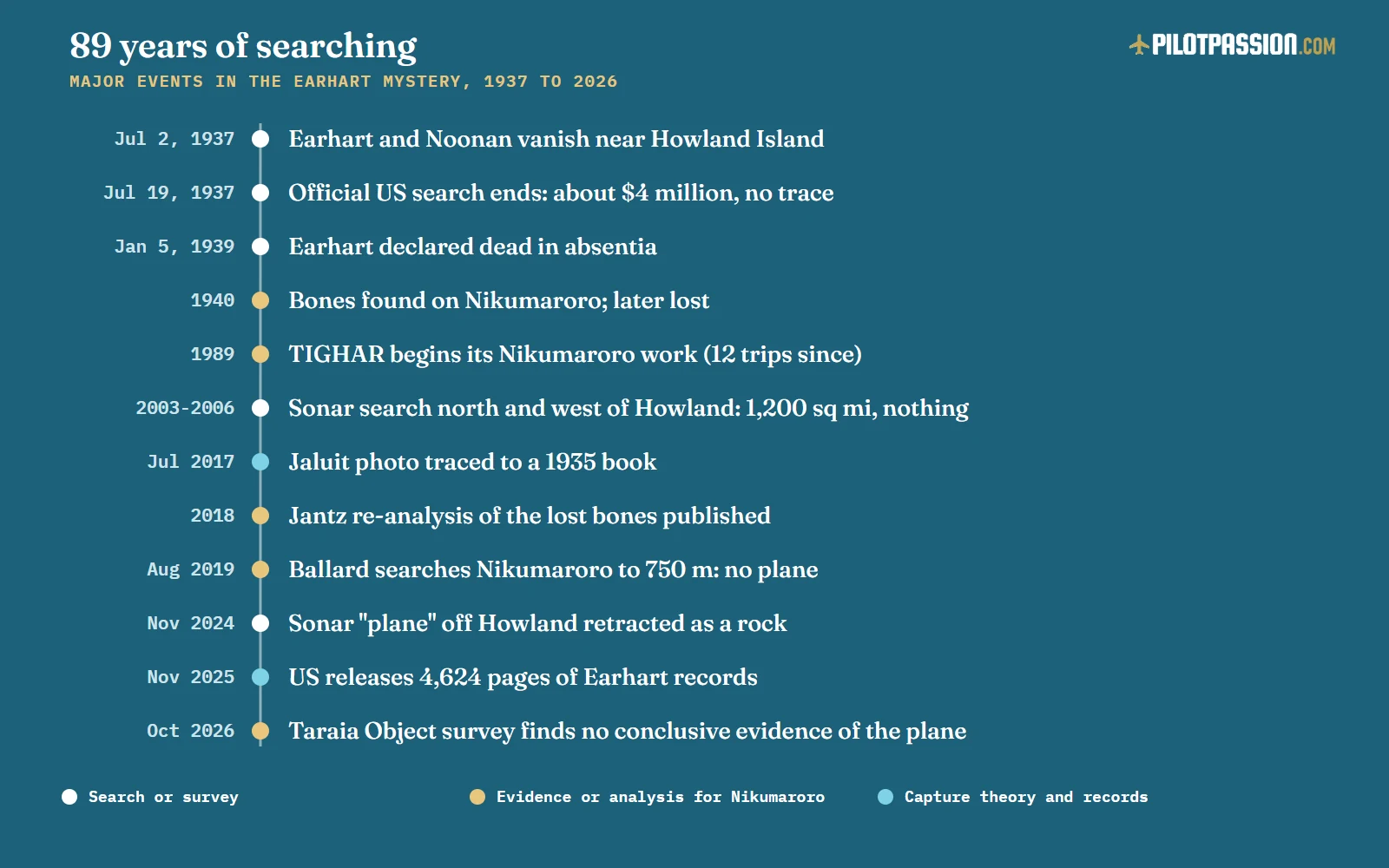
Chart by PilotPassion. Dates come from the sources listed at the end of the article.
The flight: Lae to Howland, July 2, 1937
Earhart was 39, a record-setting pilot who had worked at Purdue as a women's career counselor and aeronautics adviser from 1935. Her second attempt at a round-the-world flight began in California in May 1937 and ran eastward, with the Electra reaching Lae, New Guinea, on June 29. About 22,000 miles were behind them. Roughly 7,000 miles of Pacific remained, and the next leg was the hardest.
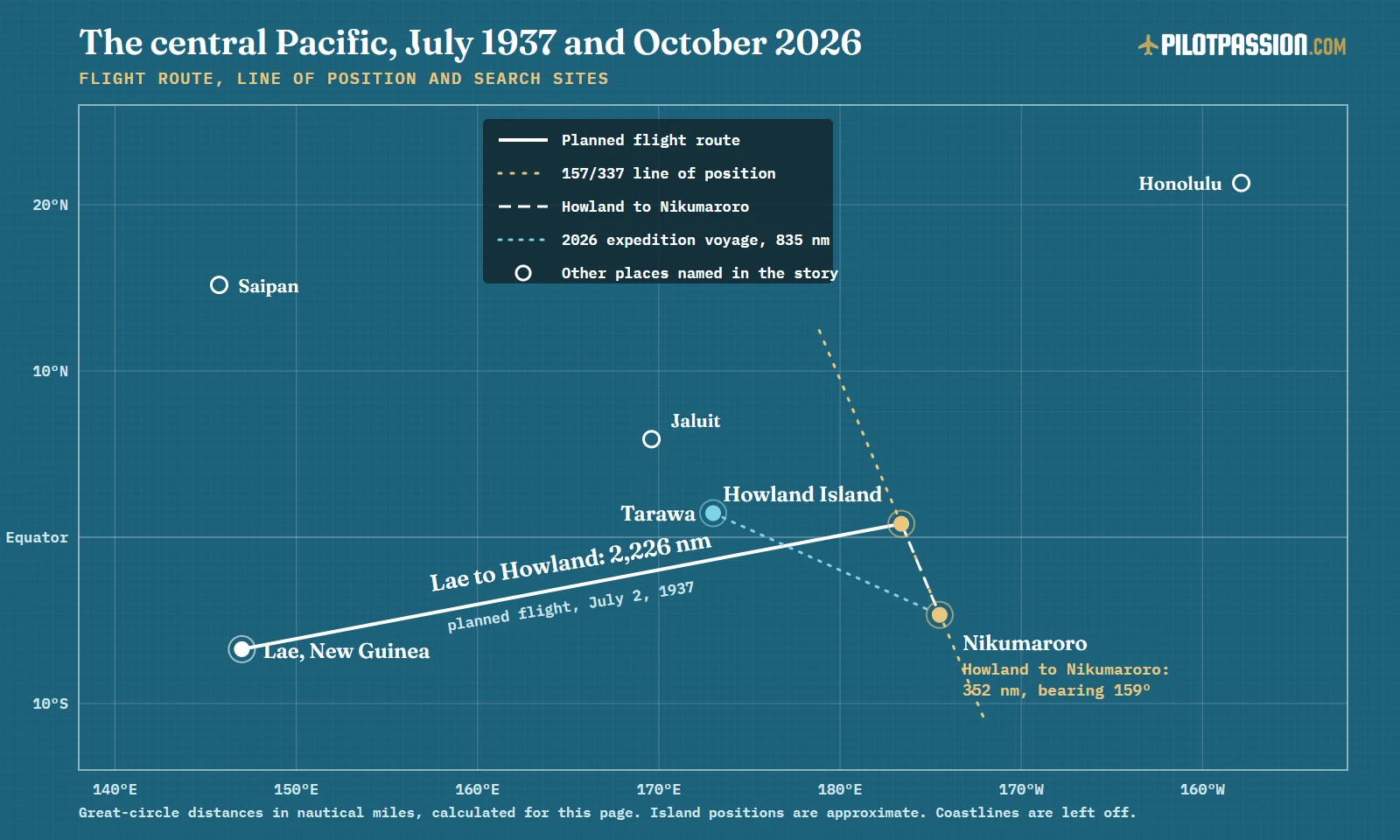
Howland Island is a speck: about 6,500 feet long, 1,600 feet wide and 10 feet high. The Electra left Lae at 10:00 am local time on July 2, heavily loaded with about 1,100 US gallons of fuel, for a leg of roughly 2,556 miles (2,200 nautical miles). The planned flight time was about 20 hours. We measured the same leg ourselves at 2,226 nautical miles, which agrees with the published figures.
Chart by PilotPassion. Great-circle distances are calculated for this page from approximate island positions. Coastlines are left off.
The US Coast Guard cutter Itasca was at Howland to help. It was meant to provide radio contact, a homing signal, a direction-finding service and a column of smoke. None of them brought the aircraft in.
The last hours, from the ship's log
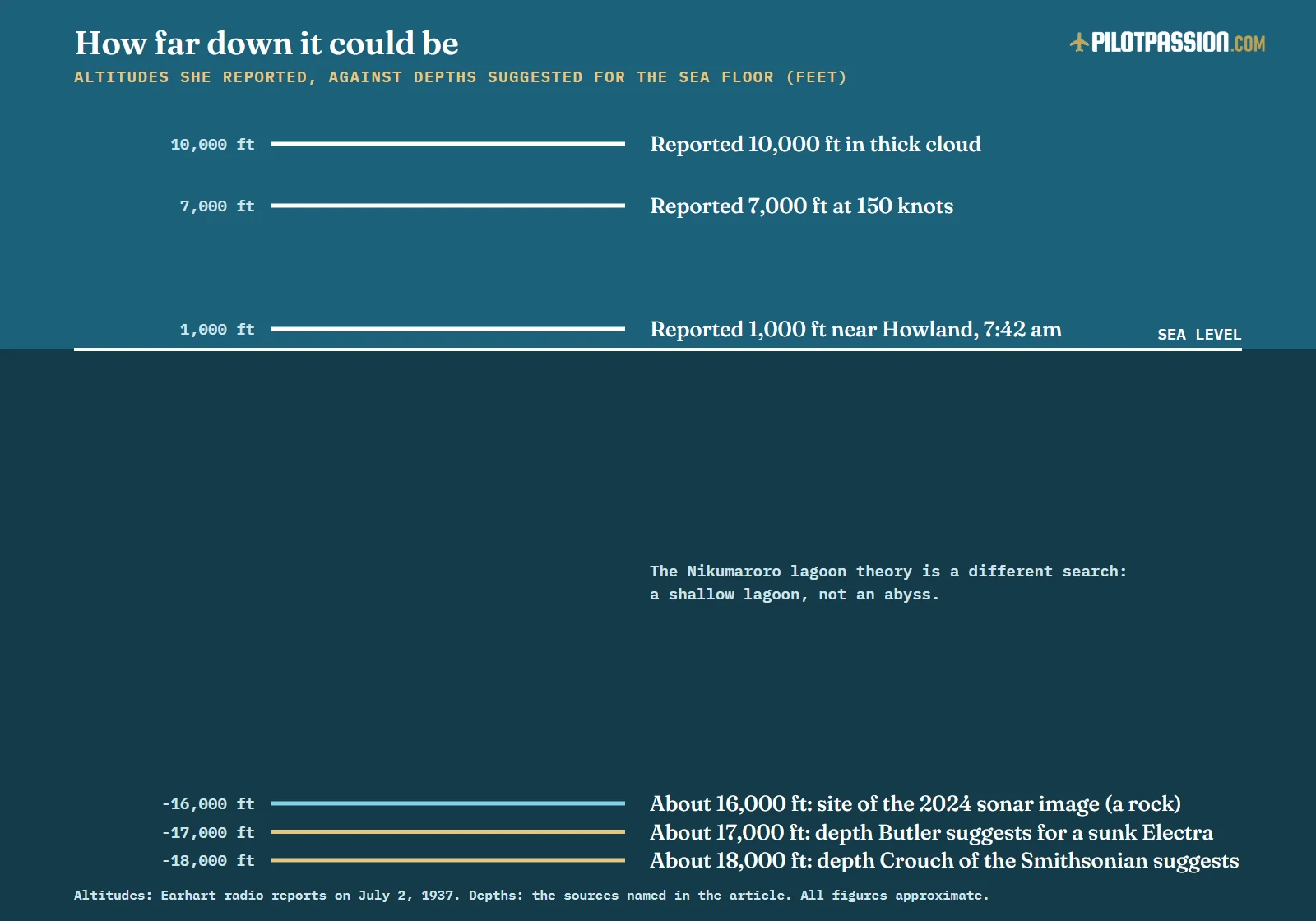
The Itasca radio log is held at the National Archives. It records Earhart's voice coming in strongly at times, but with a one-sided problem: she couldn't hear the ship's voice transmissions. Earlier in the flight she had reported 10,000 feet and thick cloud, then 7,000 feet at 150 knots.
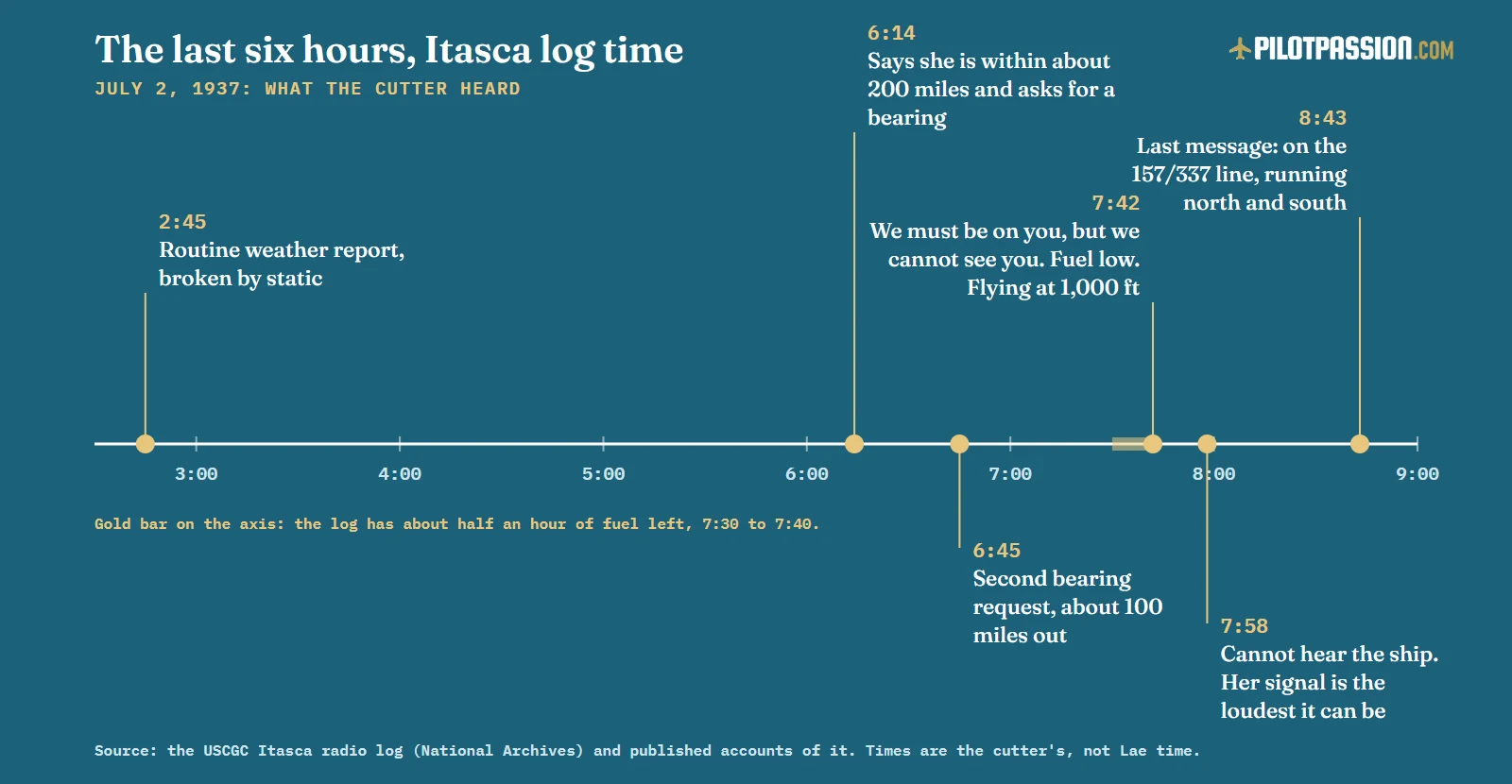
At 6:14 am by the cutter's clock she reported she was within about 200 miles and asked for a bearing, whistling into the microphone to give the ship a continuous signal. The Itasca's direction finder couldn't be tuned to her 3105 kHz frequency, and the radioman on watch later said he sat there "sweating blood" because he couldn't help.
At 6:45 she estimated 100 miles to go. At 7:42 she said, "We must be on you, but we cannot see you," added that fuel was low, and said she was flying at 1,000 feet. Around 7:58 she asked the ship to send voice signals; the Itasca logged her signal as the loudest possible, which suggests she was close, but the crew couldn't get a bearing.
The last message the cutter logged came at 8:43 am: she was on a line she gave as 157/337, running north and south, and would repeat the message on another frequency. It named no landmark. The wording of the second half is recorded as questionable in the log, and transcriptions differ.
Chart by PilotPassion from the USCGC Itasca radio log and published accounts of it. Times are the cutter's.
Why the radio failed
Several small things stacked up. The direction finder was new, and Earhart had only brief training on it; the band-setting card was mounted where she couldn't easily see it. A fuse failure had already disabled it on an earlier leg. Earhart worked in Greenwich civil time while the Itasca kept a naval time zone half an hour different, a mismatch that can have scrambled what each side expected to hear. Later research found Howland plotted about five nautical miles from its true position on the chart the crew carried. A line of position that's a few miles out matters when the island is ten feet high.
The other person on the plane: Fred Noonan
Most retellings are about Earhart. The flight was also Fred Noonan's, and finding a ten-foot-high island in the Pacific was his job.
Frederick Noonan was born in Cook County, Illinois, in 1893. He went to sea as a teenager, worked up through sailing ships and steamers, and spent roughly two decades at sea, including seven trips around Cape Horn. In the First World War he served as an officer on merchant ammunition ships and had three of them sunk under him by U-boats. He earned a master's license for steamers in 1926 and later a master's marine license for any ocean. He learned to fly in the late 1920s.
His reputation rested on his time with Pan American Airways. He taught navigation, then moved to Oakland in 1935 and navigated survey flights for the company's Pacific division, work that helped map its Pacific routes. TIGHAR's research paper on him describes him as among the foremost pioneering aerial navigators of his day. He resigned from Pan Am at the end of 1936, reportedly to start a navigation school.
He joined Earhart in early 1937 after another navigator, Harry Manning, stepped back, and he was part of the first attempt, which ended in a ground loop at Honolulu in March. Earhart's notes praise his skill, including how he could judge the wind from the look of the sea. He found the plane carried only an ordinary ship's sextant, and borrowed a bubble octant made for aircraft.
One rumor needs handling carefully. Some writers decades later said he drank himself out of a job at Pan Am. Wikipedia's article on him notes there's no contemporary evidence he was an alcoholic or was fired, and that the claim traces to a 1972 interview with a former crewmember. We treat it as unproven hearsay, not fact. His personal life in early 1937 was turbulent, with a divorce, a remarriage and two car accidents within weeks, but none of that shows how he performed on the flight.
Noonan was declared dead in absentia in June 1938. The navigation problem he faced was the hard one: a long overwater leg with few star sightings, cloud, a tiny target and radio help that didn't work. Every theory below is also a story about where Noonan's line of position put them.
The 1937 search
The Itasca began searching about an hour after the last message, north and west of Howland. The US Navy and Coast Guard joined over the next few days. The official search ended on July 19, 1937, at a cost of about $4 million, then the most expensive and intensive air and sea search the United States had run. It found nothing.
Hoaxes muddied the water: an Oakland amateur reported distress calls on July 3 and July 6, one saying they couldn't hold out much longer, and many such reports proved false. George Putnam, Earhart's husband, chartered two small boats to search nearby islands. Earhart was declared dead in absentia on January 5, 1939.
The official view: out of fuel and into the sea
The US government concluded the Electra ran out of fuel and crashed into the ocean. Many specialists agree, with different emphases. Laurance Safford's analysis in the 1970s called the flight a case of "poor planning and worse execution." Richard Black, who was involved in the 1937 effort, said the plane went into the sea around 10 am, not far from the island. Roy Nesbit has argued the Electra wasn't fully fueled at Lae. William Polhemous has suggested Noonan may have miscalculated the approach to a single line of position.
If the aircraft did go down near Howland, the sea floor is deep. Susan Butler put the depth at about 17,000 feet, and Tom Crouch of the Smithsonian at about 18,000 feet, comparing the wreck's historical significance to that of the Titanic.
Chart by PilotPassion. Depths are those cited in the sources named in the text and are approximate.
The deep-sea searches
David Jourdan searched about 1,200 square miles north and west of Howland with deep-sea sonar in 2003 and 2006, at a cost of $4.5 million, and found no wreckage.
In January 2024 a South Carolina company, Deep Sea Vision, announced sonar images of an object that might be the Electra, about 100 miles off Howland and more than 16,000 feet down. Its CEO, Tony Romeo, pointed to the flat sea floor around it and to the shape's resemblance to a plane. The team returned on November 1, 2024, imaged the target with an autonomous underwater vehicle at higher resolution, and found a natural rock formation. The company said no evidence of Earhart's disappearance had been found.
The Nikumaroro hypothesis
The best-developed alternative holds that Earhart and Noonan, unable to find Howland, flew a line to the south-southeast and landed on the reef flat at Nikumaroro, then called Gardner Island, an uninhabited atoll in what is now Kiribati. TIGHAR has pushed this idea since 1989 and built much of the modern case.
The geometry is the first plank. Earhart's last line of position, 157/337, runs through Howland. We worked out the bearing from Howland to Nikumaroro and got about 159 degrees, a distance of about 352 nautical miles, roughly 400 miles. That puts the island within about 12 nautical miles of the 157 line, which is close in an ocean this size. The ocean has other targets too: TIGHAR itself notes that Baker Island lies about 40 miles from Howland along roughly the same line.
What supports it
Bones. In 1940 a British official found 13 bones near the remains of a campfire on the island. They were shipped to Fiji, where one doctor judged them to be from an older Polynesian man and David Hoodless judged them to be from a European man. They have since been lost. Seven of Hoodless's measurements survive. In 2018 forensic anthropologist Richard Jantz compared them with estimates of Earhart's body dimensions and reported that she was more similar to the bones than 99 percent of people in a reference sample. He wrote that the most convincing argument is that they're hers unless stronger evidence emerges.
Artifacts. TIGHAR and ALI cite finds on the island including a woman's shoe, a compact, a medicine vial and a glass jar that TIGHAR says held 1930s freckle cream. At a campsite TIGHAR calls the Seven Site it found campfires, food remains and bottles. Detection dogs alerted there, though a later dig found no further bones.
The Bevington photo. A British officer photographed the island's shoreline in October 1937. TIGHAR's imaging specialist, Jeff Glickman, believes a tiny object on the reef resembles an upturned Electra landing gear. TIGHAR's own bulletin calls this a theory.
Radio. Organizers cite radio bearings taken by the US Navy, the Coast Guard and Pan American that they say converge on Nikumaroro. Those readings are the organizers' interpretation, and we found no independent confirmation of them.
What cuts against it
No aircraft. After a dozen TIGHAR trips and Robert Ballard's 2019 expedition, nobody has found the Electra. Ballard's team said it visually examined the whole island down to 750 meters and saw no sign of the plane. It recovered a metal sheet with rivet holes, and Ballard said of it, "It's not her plane."
The bones are gone. The analysis depends on 1941 measurements by a doctor who first judged them male. Jantz himself says the possibility can't be excluded, which is weaker than showing a match, and others have argued the bones were more likely a stocky European man.
Pattern-matching. The Skeptoid podcast argues TIGHAR starts from the assumption that Earhart landed and died on the island and then fits what it finds to that story. TIGHAR answers that it's testing a hypothesis and that only a small fraction of what it has collected is thought to be connected to Earhart, Noonan or the Electra.
Disputed claims, side by side
Different theories deserve different levels of trust. This table puts the main ones next to each other, using only what the sources above support.
The main claims about what happened to the Electra
Claim
Who argues it
Best evidence
Main problem
Status
Out of fuel, crashed at sea
US government; most historians
Radio log, fuel limits, no landfall reported
No wreckage found, depth makes searching very hard
Official view, unproven
Castaways on Nikumaroro
TIGHAR, Purdue and ALI
Artifacts, bones analysis, geometry of the 157 line
No aircraft found, bones lost, artifacts circumstantial
Open, team still backs it
Taraia Object is the Electra
ALI and Purdue
Satellite and 1938 aerial imagery
2026 survey: likely large trees, reflective surface was a carbonate veneer
Ruled out, October 2026
Captured by Japan
Some relatives, some authors
Unnamed witness accounts from Saipan and elsewhere
No physical evidence; the 2017 photo dates from 1935
No supporting evidence
Sonar image off Howland, 2024
Deep Sea Vision (original claim)
Plane-like shape on flat sea floor
Retested in November 2024: natural rock
Retracted
Lived on under another name
A 1970 book
None offered that survived a lawsuit
Publisher withdrew the book
Discredited
The capture claim and the 2017 photo
The belief that Japanese forces captured the pair, perhaps after they came down in Japan's Pacific island territories, has long been popular. Some relatives and researchers cite unnamed witnesses, including Japanese soldiers and Saipan residents. It has never produced a body, a document or an aircraft.
In July 2017 a History Channel documentary presented a photo from Jaluit Atoll as showing Earhart and Noonan on a dock in Japanese custody. Within days a Japanese military-history blogger, Kota Yamano, found the same photograph in a Japanese-language book published in October 1935, which dates it almost two years before the flight. TIGHAR had already pointed out that the image was undated and showed no Japanese guards. The channel said it was looking into the matter but stood behind the film.
The 2025 declassification did not change the picture. On September 26, 2025, President Trump said he had ordered all government records on Earhart declassified, and in mid-November the National Archives posted 4,624 pages, including ship logs from the search. Gillespie said most of it was already public, and Boston Globe reporting said Earhart experts judged the release a dud. Others welcomed the access anyway. Nothing in the coverage suggests the files settled any theory.
Other claims you will hear
New Britain. In 1990 a man said he had seen a wrecked aircraft in the New Britain jungle in 1945, which would place the Electra far to the west. Later searches found nothing.
Irene Bolam. A 1970 book, Amelia Earhart Lives, claimed Earhart lived on in the United States under another name. The woman it named sued for $1.5 million, and the publisher withdrew the book.
The distress calls. Radio amateurs reported messages in the days after the disappearance. The 1937 investigation treated many as hoaxes.
Why it is still unsolved
Three problems compound each other. The target area is a patch of ocean thousands of feet deep, and nobody knows the starting point of any line. The one kind of place where a plane could have come down intact, a reef flat, is also a place where, Gillespie argues, surf would have destroyed a wreck soon after landing. And the evidence that exists is mostly of the kind that can be read two ways: a bone measurement, a jar, a blur in a photograph.
That is why the Taraia survey mattered beyond this one object. It was the first plan in years that could produce a yes or no with a physical answer. The answer for the object was no. It tests one target, not the castaway hypothesis, and the wider case rests on the same circumstantial evidence it did before.
What would count as proof
The Electra was registered as NR16020. An identification would need more than a shape: structural parts that match a Lockheed Model 10-E, engine or propeller data plates, or other numbered components. At the lagoon, the team's plan was photographs and video before disturbance, remote sensing, then dredging to expose whatever was there, and any extraction needs Kiribati's permission. The 2026 survey found no such parts.
How to follow the search
The expedition's official updates are posted by Purdue University and the Purdue Research Foundation, and national outlets reported from the team. Any future search will be announced there. Treat early claims with care. Past announcements, including the 2024 sonar image and the 2017 photo, have been withdrawn or disproven within days or weeks of publication.
Keep PilotPassion in your Google results
Add us as a preferred source and we are more likely to appear in your Top Stories.