
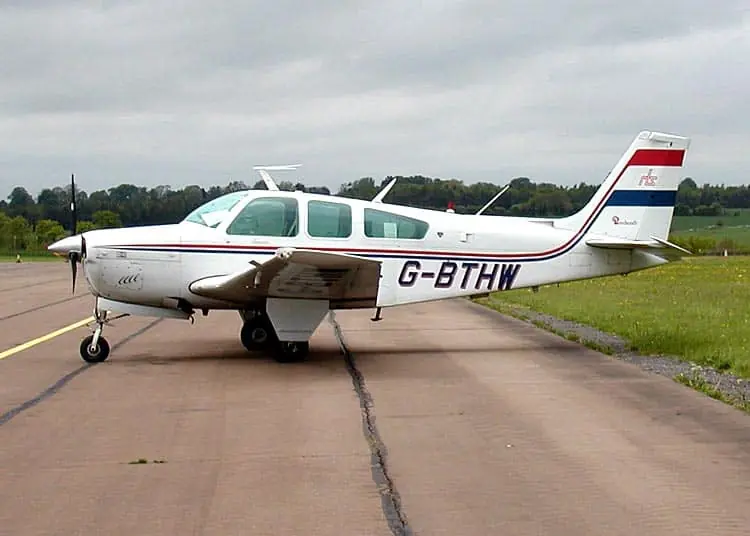
Textron lists a new G36 Bonanza at $1,404,000 in its 2026 Fact Book. A used one is a different proposition: the median asking price for a G36 in our sample is $682,000, about 49% of the list price, and the older A36 it grew from asks $369,000, 26%.
The Bonanza is Beechcraft's long-running high-end piston single. 10,374 of them sit on the FAA register, three families under one name: the V-tail 35 series, the Debonair and Bonanza 33 series, and the straight-tail 36 series. The median ask runs from $117,500 for an early V-tail to $682,000 for a G36, and the choice of series is most of what you pay for.
What follows walks down the price curve, then looks at the three series, who owns the fleet, what the airplane costs to run and what the NTSB accident files record. Every figure comes from a named public source or a dated sample, and the sources are listed at the end.
Data used: FAA fleet through 2026-10-12; NTSB file through 2026-09-30; asking-price sample 2026-10-14.
What a new Bonanza costs, and what that number means
Textron's Fact Book lists the G36 Bonanza at $1,404,000. That is a manufacturer's suggested retail price: the standard configuration, before the options, avionics choices and dealer terms that move a real quote. Textron's Fact Book is the only maker price we found, and it prices only the current G36.
The G36 has 6 seats, a 300 hp Continental IO-550-B, a maximum takeoff weight of 3,650 lb and 74 US gal of usable fuel, according to the FAA type certificate data sheet. The sheet's earliest Bonanza section, the H35 approved in 1956, had 240 hp and 2,900 lb. The G36 adds 60 hp and 750 lb.
Seven price tiers under one name
We gathered 184 Bonanza and Debonair listings from one marketplace on 14 October 2026, and 167 of them carried a usable asking price. Their medians sort the family into tiers, with the new list price as the benchmark.
The gold bar is Textron's list price for a new G36. Teal bars are medians of asking prices. Groups with fewer than 5 priced listings are left out.


The G36 stands alone. Its median ask is $682,000 and asks run from $519,000 to $1,130,000. Split by build year it climbs steadily: the 2006 to 2012 group asks a median of $601,000, 43% of the list price, and the 2013 to 2019 group asks $800,000. The 2 priced listings built from 2020 on ask $1,000,000 to $1,130,000, a sample too small for a median.
The median G36 built in 2013 to 2019 has flown 686 hours. The median 2006 to 2012 one has flown 1,656.
The A36 is the interesting airplane. Age barely moves its price until the 1990s. Built up to 1979, the median A36 asks $299,500, and from 1980 to 1989 it asks $297,500, so the older airplanes ask slightly more. Then the price steps up: $439,000 for the 1990s and $519,000 for 2000 on. The airframe hours fall at each step, from 5,175.5 to 1,787.5.
The turbocharged A36TC and B36TC ask $389,000, a little above the A36 at $369,000. The older 33 and 35 series sit below, from $261,000 for the Bonanza 33 series through $231,500 for the later V-tails to $117,500 for the early ones. The early V-tails are the cheapest Bonanzas in the sample, and their median airframe has flown 6,166 hours.
One caution covers this whole section. It is one marketplace on one day, with 167 priced listings after we set aside 15 with no price and 2 placeholder prices. Several groups have only a handful of listings, and the 33 Debonair has 5. These are asking prices, not sales, and no individual listing is published. Prices were recorded to the nearest 1,000 dollars.
For the wider market, our guide to what a small plane costs puts the Bonanza in context, and what a Beechcraft costs covers the maker. The twin from the same factory is covered in what a Beechcraft 58 Baron costs, and a modern rival in what a Cirrus SR22 costs.
Show the asking-price tables
| Model or band | Listings | Asking median (USD) | Asking range (USD) | Median total time (hours) | Sample years |
|---|---|---|---|---|---|
| G36 | 30 | $682,000 | $519,000 to $1,130,000 | 1,270 | 2006 to 2024 |
| A36 | 51 | $369,000 | $169,000 to $608,000 | 3,700 | 1970 to 2005 |
| A36TC and B36TC, turbocharged | 15 | $389,000 | $221,000 to $560,000 | 2,646 | 1979 to 2001 |
| F33A and E33A | 28 | $261,000 | $140,000 to $499,000 | 3,675.5 | 1967 to 1994 |
| C33A, 33 and A33 Debonair | 5 | $175,000 | $139,000 to $385,000 | 4,867 | 1960 to 1967 |
| V35, V35A and V35B, V-tail | 20 | $231,500 | $117,000 to $350,000 | 4,433 | 1965 to 1979 |
| Early 35 series, V-tail | 18 | $117,500 | $69,000 to $278,000 | 6,166 | 1953 to 1965 |
| Model or band | Listings | Asking median (USD) | Asking range (USD) | Median total time (hours) | Sample years |
|---|---|---|---|---|---|
| G36, 2006 to 2012 | 19 | $601,000 | $519,000 to $765,000 | 1,656 | 2006 to 2011 |
| G36, 2013 to 2019 | 9 | $800,000 | $685,000 to $860,000 | 686 | 2013 to 2019 |
| G36, 2020 on | 2 | Range only | $1,000,000 to $1,130,000 | Not shown | 2020 to 2024 |
| A36, up to 1979 | 16 | $299,500 | $169,000 to $470,000 | 5,175.5 | 1970 to 1978 |
| A36, 1980 to 1989 | 12 | $297,500 | $196,000 to $395,000 | 4,660.5 | 1980 to 1989 |
| A36, 1990 to 1999 | 15 | $439,000 | $325,000 to $499,000 | 2,270 | 1990 to 1999 |
| A36, 2000 on | 8 | $519,000 | $359,000 to $608,000 | 1,787.5 | 2000 to 2005 |
Three series, one name
The FAA's type certificate data sheet covers all three series under one number. The V-tail 35 series came first, the 33 series put the Bonanza's engine in a conventional tail from 1959, and the 36 series stretched the airplane in 1968. Six rows tell most of the story. For where the Bonanza sits among the rest, the guide to the main types of planes helps.
- 285 hp, Continental
- 3,300 lb maximum takeoff weight
- 44 US gal usable fuel
- 285 hp, Continental
- 3,400 lb maximum takeoff weight
- 44 US gal usable fuel
- 285 hp, Continental
- 3,400 lb maximum takeoff weight
- 44 US gal usable fuel
- 285 hp, Continental
- 3,600 lb maximum takeoff weight
- 44 US gal usable fuel
- 300 hp, Continental
- 3,850 lb maximum takeoff weight
- 102 US gal usable fuel
- 300 hp, Continental
- 3,650 lb maximum takeoff weight
- 74 US gal usable fuel
Power crept up from 240 hp on the earliest row to 300 hp on the G36, and the turbocharged B36TC carries the biggest fuel load, 102 US gal usable. The register counts the series very differently: the 35 series has 5,051 aircraft (48.7%), the 36 series 3,328 (32.1%) and the 33 series 1,992 (19.2%).
Looking for something with more engines? The twin Baron is covered in what a Beechcraft 58 Baron costs, and a six-seat single alternative in the six-seater guide.
Show the full model comparison table
| Model and approval year | Certified specification | Ownership context |
|---|---|---|
| H35Approved: 1956 FAA sheet | Continental O-470-G 240 hpMaximum takeoff weight: 2,900 lbFuel, total / usable: 40 US gal / 34 US galSeating: 4 seats | Registered: 224 all registrations; 220 valid (status V)Asking median: Not shown for this designationPrimary engine TBO: No applicable primary schedule retrieved |
| J35Approved: 1957 FAA sheet | Continental IO-470-C 250 hpMaximum takeoff weight: 2,900 lbFuel, total / usable: 40 US gal / 34 US galSeating: 4 seats | Registered: 221 all registrations; 217 valid (status V)Asking median: Not shown for this designationPrimary engine TBO: No applicable primary schedule retrieved |
| K35Approved: 1958 FAA sheet | Continental IO-470-C 250 hpMaximum takeoff weight: 2,950 lbFuel, total / usable: 50 US gal / 44 US galSeating: 4 seats | Registered: 237 all registrations; 236 valid (status V)Asking median: Not shown for this designationPrimary engine TBO: No applicable primary schedule retrieved |
| M35Approved: 1959 FAA sheet | Continental IO-470-C 250 hpMaximum takeoff weight: 2,950 lbFuel, total / usable: 50 US gal / 44 US galSeating: 4 seats | Registered: 225 all registrations; 222 valid (status V)Asking median: Not shown for this designationPrimary engine TBO: No applicable primary schedule retrieved |
| 35-33Approved: 1959 FAA sheet | Continental IO-470-J 225 hpMaximum takeoff weight: 2,900 lbFuel, total / usable: 50 US gal / 44 US galSeating: 4 seats | Registered: 130 all registrations; 128 valid (status V)Asking median: Not shown for this designationPrimary engine TBO: No applicable primary schedule retrieved |
| N35Approved: 1960 FAA sheet | Continental IO-470-N 260 hpMaximum takeoff weight: 3,125 lbFuel, total / usable: 50 US gal / 44 US galSeating: 4 seats | Registered: 167 all registrations; 167 valid (status V)Asking median: Not shown for this designationPrimary engine TBO: No applicable primary schedule retrieved |
| 35-A33Approved: 1960 FAA sheet | Continental IO-470-J The FAA sheet prints a speed unit where a horsepower unit is expected. Horsepower is not given here.Maximum takeoff weight: 3,000 lbFuel, total / usable: 50 US gal / 44 US galSeating: 4 seats | Registered: 85 all registrations; 83 valid (status V)Asking median: Not shown for this designationPrimary engine TBO: No applicable primary schedule retrieved |
| 35-B33Approved: 1961 FAA sheet | Continental IO-470-K 225 hpMaximum takeoff weight: 3,000 lbFuel, total / usable: 44 US gal / 44 US galSeating: 4 seats | Registered: 291 all registrations; 289 valid (status V)Asking median: Not shown for this designationPrimary engine TBO: No applicable primary schedule retrieved |
| P35Approved: 1961 FAA sheet | Continental IO-470-N 260 hpMaximum takeoff weight: 3,125 lbFuel, total / usable: 44 US gal / 44 US galSeating: 4 seats | Registered: 319 all registrations; 313 valid (status V)Asking median: Not shown for this designationPrimary engine TBO: No applicable primary schedule retrieved |
| S35Approved: 1964 FAA sheet | Continental IO-520-B or IO-520-BA 285 hpMaximum takeoff weight: 3,300 lbFuel, total / usable: 50 US gal / 44 US galSeating: 4 seats | Registered: 459 all registrations; 454 valid (status V)Asking median: Not shown for this designationPrimary engine TBO: No applicable primary schedule retrieved |
| 35-C33Approved: 1964 FAA sheet | Continental IO-470-K 225 hpMaximum takeoff weight: 3,050 lbFuel, total / usable: 50 US gal / 44 US galSeating: 4 seats | Registered: 186 all registrations; 185 valid (status V)Asking median: Not shown for this designationPrimary engine TBO: No applicable primary schedule retrieved |
| E33Approved: 1967 FAA sheet | Continental IO-470-K 225 hpMaximum takeoff weight: 3,050 lbFuel, total / usable: 50 US gal / 44 US galSeating: 4 seats | Registered: 63 all registrations; 63 valid (status V)Asking median: Not shown for this designationPrimary engine TBO: No applicable primary schedule retrieved |
| F33Approved: 1969 FAA sheet | Continental IO-470-K 225 hpMaximum takeoff weight: 3,050 lbFuel, total / usable: 50 US gal / 44 US galSeating: 4 seats | Registered: 14 all registrations; 14 valid (status V)Asking median: Not shown for this designationPrimary engine TBO: No applicable primary schedule retrieved |
| V35Approved: 1965 FAA sheet | Continental IO-520B or IO-520-BA 285 hpMaximum takeoff weight: 3,400 lbFuel, total / usable: 50 US gal / 44 US galSeating: 4 seats | Registered: 425 all registrations; 419 valid (status V)Asking median: Not shown for this designationPrimary engine TBO: No applicable primary schedule retrieved |
| V35AApproved: 1967 FAA sheet | Continental IO-520B or IO-520-BA 285 hpMaximum takeoff weight: 3,400 lbFuel, total / usable: 50 US gal / 44 US galSeating: 4 seats | Registered: 321 all registrations; 319 valid (status V)Asking median: Not shown for this designationPrimary engine TBO: No applicable primary schedule retrieved |
A fleet from the sixties
The FAA register lists 10,374 aircraft in the Bonanza family, and 10,261 of them (98.9%) hold a valid registration, while 113 carry another status. Of the whole family, 7,991 records have a usable build year, and 7,924 of those are valid. That counts paperwork, not airplanes in the air: a valid registration says nothing about whether the aircraft is airworthy or flying.
The most common label is the A36 with 2,356 records, then the Bonanza F33A with 977 and the V-tail V35B with 913.
- 8221950s
- 2,6031960s
- 2,0901970s
- 1,1821980s
- 7921990s
- 3282000s
- 1472010s
- 272020s
2,383 records have a blank or invalid build year and are left out of the chart.
58.7% of the registered Bonanzas with a usable build year were built in the 1960s or 1970s.
The 1960s account for 2,603 aircraft and the 1970s for 2,090. The register thins to 1,182 from the 1980s and 792 from the 1990s, and almost vanishes after that: 328 from the 2000s, 147 from the 2010s and 27 so far in the 2020s.
Individuals hold the most registrations, at 46.0%. LLCs follow at 28.3%, then corporations at 12.2% and co-owned aircraft at 11.9%. The registry records the owner category, not how the airplane is used.
Texas (12.6%) and California (11.2%) lead the state table, 147 aircraft apart, with Florida (6.4%) third. Arizona is fourth and Delaware, with 353 registrations, fifth: a registration-address effect, because LLC and trust registrations can carry a Delaware address. The state field says nothing about where the aircraft fly.
Download the fleet CSV by model and build year. Free to use, please link back. It counts all registrations and valid ones (status V) by model label and build year, including blank years, and contains no personal records.
Show the fleet tables
| Group | All registrations | Valid (status V) | Share of all registrations |
|---|---|---|---|
| 33-series Bonanza and Debonair registry labels | 1,992 | 1,978 | 19.2% |
| 35-series Bonanza registry labels | 5,051 | 4,976 | 48.7% |
| 36-series Bonanza registry labels | 3,328 | 3,304 | 32.1% |
| 33, 35 and 36 registry labels with unresolved certified identities | 3 | 3 | 0.0% |
| Model label | All registrations | Valid (status V) |
|---|---|---|
| A36 | 2,356 | 2,343 |
| F33A | 977 | 971 |
| V35B | 913 | 903 |
| S35 | 459 | 454 |
| V35 | 425 | 419 |
| G36 | 380 | 374 |
| V35A | 321 | 319 |
| P35 | 319 | 313 |
| B36TC | 307 | 304 |
| 35-B33 | 291 | 289 |
| 35 | 266 | 258 |
| C35 | 258 | 252 |
| K35 | 237 | 236 |
| M35 | 225 | 222 |
| G35 | 224 | 219 |
| Build decade | All registrations | Share of known years | Valid (status V) | Valid share of known years |
|---|---|---|---|---|
| 1950s | 822 | 10.3% | 811 | 10.2% |
| 1960s | 2,603 | 32.6% | 2,577 | 32.5% |
| 1970s | 2,090 | 26.2% | 2,074 | 26.2% |
| 1980s | 1,182 | 14.8% | 1,175 | 14.8% |
| 1990s | 792 | 9.9% | 787 | 9.9% |
| 2000s | 328 | 4.1% | 327 | 4.1% |
| 2010s | 147 | 1.8% | 146 | 1.8% |
| 2020s | 27 | 0.3% | 27 | 0.3% |
| FAA code | Registrant type | All registrations | Valid (status V) | Share of all registrations |
|---|---|---|---|---|
| 1 | Individual | 4,772 | 4,675 | 46.0% |
| 2 | Partnership | 134 | 134 | 1.3% |
| 3 | Corporation | 1,265 | 1,259 | 12.2% |
| 4 | Co-Owned | 1,236 | 1,236 | 11.9% |
| 5 | Government | 14 | 14 | 0.1% |
| 7 | LLC | 2,939 | 2,937 | 28.3% |
| 8 | Non Citizen Corporation | 12 | 6 | 0.1% |
| unknown | Missing or unlisted registrant type | 2 | 0 | 0.0% |
| 9 | Non Citizen Co-Owned | 0 | 0 | No records |
| State | All registrations | Valid (status V) | Share of all registrations |
|---|---|---|---|
| TX | 1,312 | 1,299 | 12.6% |
| CA | 1,165 | 1,157 | 11.2% |
| FL | 667 | 659 | 6.4% |
| AZ | 381 | 374 | 3.7% |
| DE | 353 | 348 | 3.4% |
| TN | 340 | 336 | 3.3% |
| GA | 306 | 303 | 2.9% |
| OK | 303 | 295 | 2.9% |
| NC | 281 | 281 | 2.7% |
| CO | 273 | 270 | 2.6% |
Show every exact FAA model label
| Model label | All registrations | Valid (status V) |
|---|---|---|
| A36 | 2,356 | 2,343 |
| F33A | 977 | 971 |
| V35B | 913 | 903 |
| S35 | 459 | 454 |
| V35 | 425 | 419 |
| G36 | 380 | 374 |
| V35A | 321 | 319 |
| P35 | 319 | 313 |
| B36TC | 307 | 304 |
| 35-B33 | 291 | 289 |
| 35 | 266 | 258 |
| C35 | 258 | 252 |
| K35 | 237 | 236 |
| M35 | 225 | 222 |
| G35 | 224 | 219 |
| H35 | 224 | 220 |
| J35 | 221 | 217 |
| F35 | 192 | 189 |
| 35-C33 | 186 | 185 |
| A36TC | 174 | 172 |
| N35 | 167 | 167 |
| A35 | 160 | 154 |
| B35 | 148 | 147 |
| D35 | 142 | 140 |
| E35 | 141 | 138 |
| 35-33 | 130 | 128 |
| 35-C33A | 113 | 113 |
| 36 | 111 | 111 |
| 35-A33 | 85 | 83 |
| E33 | 63 | 63 |
| E33A | 51 | 50 |
| G33 | 41 | 41 |
| E33C | 21 | 21 |
| F33C | 17 | 17 |
| F33 | 14 | 14 |
| 35R | 7 | 7 |
| 33 | 2 | 2 |
| A36AT | 1 | 1 |
| B35-33 | 1 | 1 |
| B36T | 1 | 1 |
| C-33A | 1 | 1 |
| V35-TC | 1 | 1 |
| V35A-TC | 1 | 1 |
| Total | 10,374 | 10,261 |
The list price is only the entry fee
After the purchase the airplane wants fuel, an engine fund, an annual inspection, insurance and somewhere to sleep. Only some of those have a published number worth printing, and for the Bonanza few do.
Fuel
Plane and Pilot's specification table for the 1975 A36 gives 15.2 US gal/hour at 75 percent power, 13.3 US gal/hour at 65 percent and 11.5 US gal/hour at 45 percent. That is one A36 from one model year, not the family, so the calculator leaves fuel burn for you to fill in.
Turn the burn into money with your own fuel price. At an example $6.00 a gallon, the 1975 A36 burns $91.20 of fuel an hour at 75 percent power. At $9.00 it is $136.80. Those prices are examples chosen to show the arithmetic, not market data.
The engine
Every Bonanza on the data sheet has a Continental engine, the IO-520 family, the IO-550-B on the G36 and the TSIO-520 on the turbocharged models. Continental's current overhaul schedule sits behind an account login we could not use, so we publish no overhaul interval for any of them. Ask the shop that would do the work. The engine is the line item that arrives all at once.
The rest
The FAA describes an annual inspection interval of 12 calendar months for ordinary US personal aircraft ownership. Insurance, hangar or tie-down fees, labour rates and loan terms depend too much on the owner, the airfield and the airplane for one published number to mean anything, so this page prints none. Add your own quotes and you have a budget that belongs to you. More on the wider costs of owning an aircraft sits in our ownership section.
Renting is the benchmark your own figure has to justify. Our guide to how much it costs to rent a Cessna 172 shows the other side of the ledger for a smaller airplane.
Show the fuel tables
| Model year | Power setting | Fuel burn | Source |
|---|---|---|---|
| 1975 A36 | 75 percent power | 15.2 US gal/hour | Plane and Pilot spec table; retrieved 2026-10-14 |
| 1975 A36 | 65 percent power | 13.3 US gal/hour | Plane and Pilot spec table; retrieved 2026-10-14 |
| 1975 A36 | 45 percent power | 11.5 US gal/hour | Plane and Pilot spec table; retrieved 2026-10-14 |
| Model year and power | $5.00/gal | $6.00/gal | $7.00/gal | $8.00/gal | $9.00/gal |
|---|---|---|---|---|---|
| 1975 A36 75 percent | $5.00/gal: $76.00 | $6.00/gal: $91.20 | $7.00/gal: $106.40 | $8.00/gal: $121.60 | $9.00/gal: $136.80 |
| 1975 A36 65 percent | $5.00/gal: $66.50 | $6.00/gal: $79.80 | $7.00/gal: $93.10 | $8.00/gal: $106.40 | $9.00/gal: $119.70 |
| 1975 A36 45 percent | $5.00/gal: $57.50 | $6.00/gal: $69.00 | $7.00/gal: $80.50 | $8.00/gal: $92.00 | $9.00/gal: $103.50 |
What the accident files record
Every entry in the NTSB files is a real event, and the counts are all this page claims to know about them. The NTSB lists 1,184 accidents involving Bonanza-family aircraft from 2000 through 2025. Of those, 407, or 34.4%, were fatal, and 775 people died in them.
- 2000
- 73
- 2005
- 2010
- 2015
- 2020
- 402025
Counts only. The NTSB does not record how many hours the family flew, so these bars are not rates.
The count peaked at 73 in 2003 and stood at 40 in 2025. That is a drop in the number of accidents. It should not be read as a change in risk, because the data holds no flying hours to divide by, and the fleet itself has aged.
The first coded phase is the one attached to the first event in the NTSB's sequence for each accident. Accidents without a coded sequence, or with unmapped codes, sit in separate rows of the full table.
Approach leads, by a single accident. 18.5% of accidents begin there and 18.4% begin enroute, a gap of 1. Landing follows at 15.8% and takeoff at 13.2%. Together landing and takeoff are 29.0% of the record.
The NTSB's own findings point at machines slightly more often than people here. Of the 669 accidents with causal findings in its current coding, 77.6% involve aircraft issues and 72.0% involve personnel issues. An accident can carry several findings, so the shares overlap and do not add up to the whole.
Show the NTSB tables
| Year | Accidents | Fatal accidents |
|---|---|---|
| 2000 | 55 | 17 |
| 2001 | 41 | 15 |
| 2002 | 62 | 23 |
| 2003 | 73 | 35 |
| 2004 | 43 | 14 |
| 2005 | 63 | 21 |
| 2006 | 51 | 22 |
| 2007 | 47 | 14 |
| 2008 | 47 | 15 |
| 2009 | 52 | 15 |
| 2010 | 46 | 19 |
| 2011 | 37 | 11 |
| 2012 | 51 | 13 |
| 2013 | 44 | 14 |
| 2014 | 34 | 9 |
| 2015 | 54 | 23 |
| 2016 | 29 | 11 |
| 2017 | 28 | 14 |
| 2018 | 47 | 13 |
| 2019 | 49 | 15 |
| 2020 | 36 | 16 |
| 2021 | 44 | 14 |
| 2022 | 38 | 10 |
| 2023 | 42 | 13 |
| 2024 | 31 | 10 |
| 2025 | 40 | 11 |
| Phase of flight | Accidents | Share of all accidents |
|---|---|---|
| Approach | 219 | 18.5% |
| Enroute | 218 | 18.4% |
| Landing | 187 | 15.8% |
| Takeoff | 156 | 13.2% |
| Cruise | 94 | 7.9% |
| Initial Climb | 83 | 7.0% |
| Maneuvering | 62 | 5.2% |
| Prior to Flight | 37 | 3.1% |
| Descent | 20 | 1.7% |
| Climb | 17 | 1.4% |
| Taxi | 15 | 1.3% |
| Emergency or uncontrolled descent | 13 | 1.1% |
| Other, unknown or not coded | 63 | 5.3% |
| Total | 1,184 | 100.0% |
| Group | Accidents | Share of all | Share of coded subset |
|---|---|---|---|
| Aircraft | 519 | 43.8% | 77.6% |
| Personnel issues | 482 | 40.7% | 72.0% |
| Environmental issues | 129 | 10.9% | 19.3% |
| Organizational issues | 6 | 0.5% | 0.9% |
| Not determined | 97 | 8.2% | 14.5% |
| Group | Accidents | Share of all | Share of coded subset |
|---|---|---|---|
| Aircraft/Environment | 252 | 21.3% | 61.3% |
| Human Performance | 383 | 32.3% | 93.2% |
| Direct Underlying Factors | 62 | 5.2% | 15.1% |
| Indirect Underlying Factors | 1 | 0.1% | 0.2% |
| Manufacture band | Accidents | Share of all |
|---|---|---|
| Year of manufacture 1956 to 2025 | 416 | 35.1% |
| Unknown year of manufacture | 768 | 64.9% |
| Family aircraft in different manufacture-year bands | 0 | 0.0% |
What to take from the numbers
- Pick a series before you pick an airplane. In our sample the median ask runs from $117,500 for an early V-tail to $682,000 for a G36, with the A36 at $369,000.
- An older A36 is not a cheaper A36. Built up to 1979 it asks $299,500 and built from 1980 to 1989 it asks $297,500. Price follows condition and avionics more than age until the 1990s.
- Treat an asking price as an opening line. These are what sellers want. The sample cannot see what buyers pay.
- Ask for engine time since overhaul, not only airframe hours. The airframe medians in our sample run from 1,270 for the G36 to 6,166 for the early V-tails, and the engine's own history is a separate number.
- Do not read a valid registration as a clean bill of health. Status V is paperwork, not an inspection.
- Budget with your own quotes. At 15.2 US gal/hour and an example $6.00 a gallon, a 1975 A36 burns $91.20 of fuel an hour, before the engine fund, the annual inspection, insurance and storage.
Questions buyers ask
How much does a new Beechcraft Bonanza cost?
Textron lists a new 2026 G36 Bonanza at $1,404,000 MSRP in its Fact Book. Real quotes vary with options and dealer terms.
How much does a used Beechcraft Bonanza cost?
In a one-day sample of asking prices on Controller.com, the median ask was $682,000 for a G36, $369,000 for an A36, $231,500 for a V35 series V-tail and $117,500 for an early V-tail. Those are asking prices, not sales.
What does the Bonanza burn per hour?
Plane and Pilot gives 15.2 US gal/hour at 75 percent power for a 1975 A36, which is $91.20 an hour at an example $6.00 a gallon. Engine reserve, insurance, storage and inspections come on top, so price them with your own quotes.
How many Beechcraft Bonanzas are there?
The FAA register lists 10,374 aircraft in the Bonanza family, 10,261 with a valid registration. The A36 is the most common label, with 2,356 records.
How many Beechcraft Bonanza accidents has the NTSB recorded?
The NTSB files hold 1,184 accidents from 2000 through 2025, 407 of them fatal. These are counts, not rates, because flying hours by model are not published.
Keep PilotPassion in your Google results
Add us as a preferred source and we are more likely to appear in your Top Stories.
Sources and how the numbers were made
Data through: FAA 2026-10-12; NTSB 2026-09-30; asking sample 2026-10-14.
How the numbers were made: We counted matching FAA registrations and showed valid registrations (status V) separately. We combined the NTSB files, counted each accident once and excluded incidents. Used prices are summaries of advertised prices. Fuel cost examples multiply published fuel burn by example fuel prices.
Privacy: No personal data is used in the published results. No owner, seller, crew, operator, narrative or individual accident record is published.
- Federal Aviation Administration. Releasable Aircraft Database. Retrieved 2026-10-13. The registry supplies fleet counts by model, build year, registrant type and state.
Source SHA-256:ad4497553c4b71a14e7a0768b2e9c66974998ced50177a963b7942eabc259dec - Federal Aviation Administration. Aircraft Registration Database Description. Retrieved 2026-10-13. This document explains registration status and registrant-type codes.
- National Transportation Safety Board. Aviation accident data: avall. Retrieved 2026-10-13. The later accident file supplies counts, fatal outcomes, phases of flight, findings and manufacture years.
Source SHA-256:bc74fefb1b39e1b86700a4be82b8ff6014bb1f6d81008524de73f2ddbd38b052
Database SHA-256:c891b8a6fe55651294a0cb0fa328e5648833caf5ac62b1c21d6caf3ea5e99bb7 - National Transportation Safety Board. Historical aviation accident data: Pre2008. Retrieved 2026-10-13. The historical accident file supplies earlier counts and its own phase and finding categories.
Source SHA-256:89e2df6d848e7ab3b42e7d7c7a03ff403303057a26ca04c95b3ea67201c3ce74
Database SHA-256:c2102e7e9f6773ab25c5564904db9b02d0a6d58ad8e73b3e9accda349ea85b9a - National Transportation Safety Board. Aviation data dictionaries. Retrieved 2026-10-13. Each file's dictionary defines the accident codes used here.
- National Transportation Safety Board. Aviation data download directory. Retrieved 2026-10-13. The directory gives the accident files' release dates.
- National Transportation Safety Board. Aviation database release notes. Retrieved 2026-10-13. The release notes explain file coverage and how causes and contributing factors are marked.
- National Transportation Safety Board. Aviation accident database query help. Retrieved 2026-10-13. The help page explains event dates, first phases, investigation status and limits on foreign investigations.
- National Transportation Safety Board. Aviation accident database. Retrieved 2026-10-13. The database page explains the geographic limits of these accident records.
- Federal Aviation Administration. General Aviation and Part 135 Activity Survey. Retrieved 2026-10-13. The survey reports flight hours by aircraft category, which cannot support a model accident rate.
- Federal Aviation Administration. Type Certificate Data Sheet No. 3A15. Retrieved 2026-10-14. The FAA sheet gives certified engines, ratings, weights, fuel capacities and seating for the covered models.
Source SHA-256:1a719e365e951197f60ddd48f033c5cc1729d21d46b751a17f9fd02b3fe8f76f
Text SHA-256:832c2e01ea5b903e810f7d201c698c229f22ab589f5a39d667cfa204b8923b5f - Federal Aviation Administration. Pilot Handbook of Aeronautical Knowledge. Glossary. Retrieved 2026-10-13. The glossary explains the annual inspection interval.
Source SHA-256:210d7cebd33f4094af682b49cb83a93505bebfe3d22e7db4de25dbdaa5476140 - Plane and Pilot. 1975 A36 Bonanza. Retrieved 2026-10-14. The specification table gives fuel consumption for the stated model year and power settings.
- Textron Inc. Textron Fact Book 2025. Retrieved 2026-10-14. The Fact Book gives the new aircraft MSRP for the named models.
Source SHA-256:da8915482a3206a16a3d572899426e730be221f9fa6147b7494e2148121afd83
Text SHA-256:20d6831f2555f51b59e14fabec670ab0da2756e311f0768359031aea830fe043 - Controller.com. Beechcraft Bonanza aircraft for sale. Retrieved 2026-10-14. The advertised prices supply model medians, ranges and airframe hours for the dated sample.
Send corrections and a supporting source through the contact page. We check each correction against the source.