
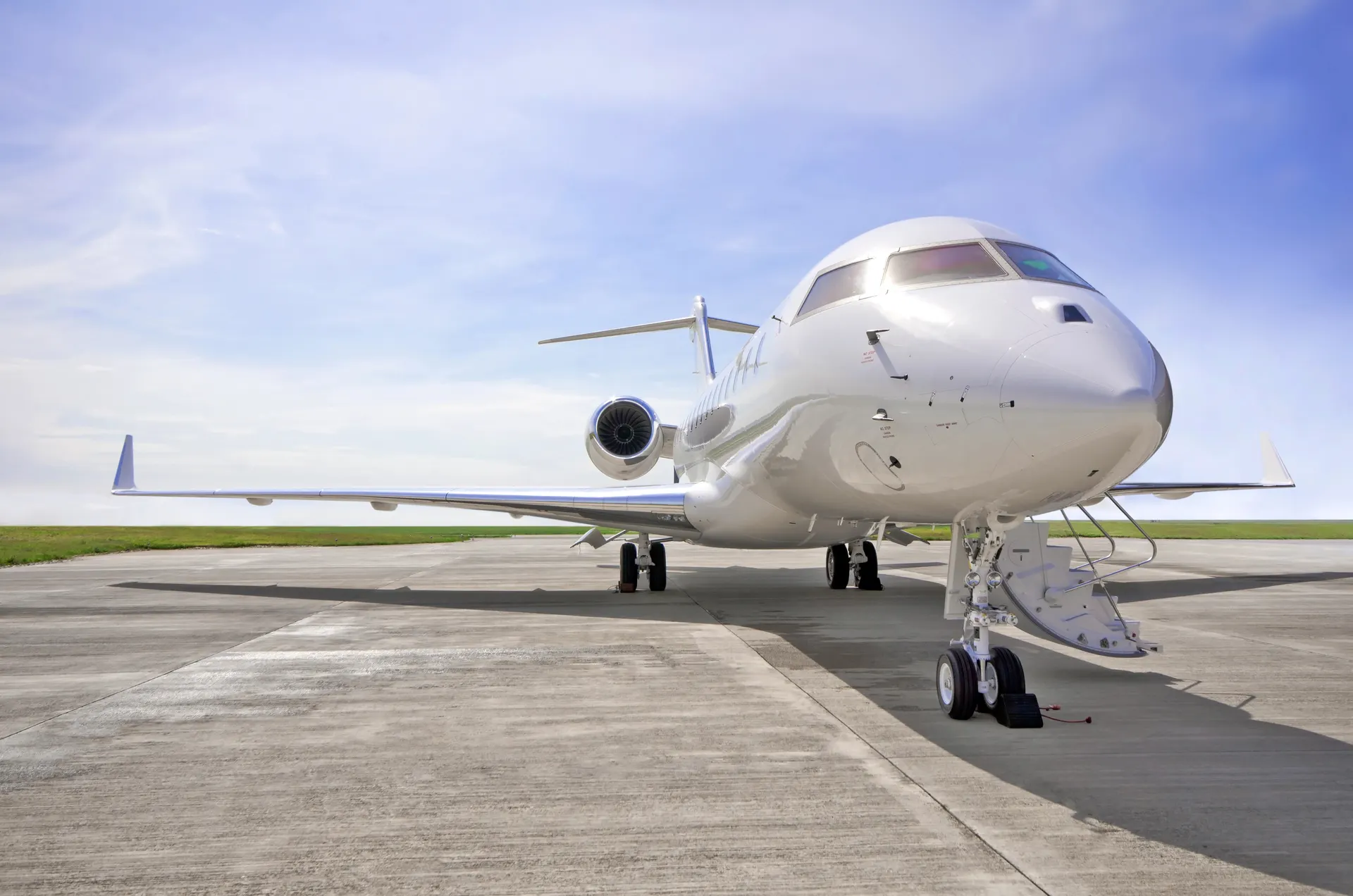
Bombardier sells two families of business jet and does not publish a price for either. The Challenger is the workhorse. The Global is the flagship. The trade press reports a Challenger 350 at $26.7 million and a Global 7500 at $78 million, a gap of 2.9 times, and the newest Global 8000 figure is $85 million.
Behind those numbers sits a fleet of 2,138 valid US registrations. The register shows who holds them, how many sit in fractional programs, and where they go when US owners are done.
Data used: FAA registry through 2026-10-16; NTSB files through 2026-09-30. Source periods are shown with each table.
Two families, one handbook, a wide range
Bombardier does not publish a price list. The trade press reports two kinds of number: a launch or unit price at an announcement, and a typically equipped price in Business & Commercial Aviation's Purchase Planning Handbook. The handbook sits behind a paywall that we did not open, so we read its figures as reported by other aviation sites and name the original and the year beside each.
Show every reported price with its year and source
Bombardier publishes no price list. These are dated reported figures, not quotes. Figures marked used are second-hand ranges for the stated model years.
Global 7500
- 2023$78 millionequipped. As reported by Business & Commercial Aircraft, Purchase planning handbook, Jets and Ultra long-range Jets tables, Q2 2023.
Global 8000
- 2023$81 millionequipped. As reported by Business & Commercial Aircraft, Purchase planning handbook, Jets and Ultra long-range Jets tables, Q2 2023.
- 2026$85 millionequipped. As reported by Business & Commercial Aviation, 2026 Purchase Planning Handbook, as reported by GlobalAir (Q1 2026) and Flycraft (October 2026).
Challenger 350
- 2021$26.7 millionequipped. As reported by Business & Commercial Aircraft, Purchase Planning Handbook, Q2 2021.
Challenger 3500
- 2023$27.2 millionequipped. As reported by Business & Commercial Aircraft, Purchase planning handbook, Jets and Ultra long-range Jets tables, Q2 2023.
Challenger 300
- 2004$17.4 millionunit. As reported by Flight International, 'Flight test: Bombardier Challenger 300 - Polished player', 3 Feb 2004.
Challenger 650
- 2023$33 millionequipped. As reported by Business & Commercial Aircraft, Purchase planning handbook, Jets and Ultra long-range Jets tables, Q2 2023.
Challenger 604
- 2016$4 million to $8 millionused. As reported by Fred George, Business & Commercial Aviation, 'Used Aircraft Report: Challenger 604', 25 Aug 2016. early models about 4.0 to 4.5, late models under 8.
Start at the top. The Global 8000 was reported at $81 million in 2023 and at $85 million in 2026, 1.05 times the earlier figure. Its sibling, the Global 7500, was reported at $78 million in the same 2023 handbook.
The Challenger line is cheaper by a long way. The Challenger 350 was reported at $26.7 million in 2021, the Challenger 3500 at $27.2 million in 2023, and the older Challenger 650 at $33 million. Further down, the original Challenger 300 was reported at $17.4 million when it was new in 2004, and a used Challenger 604 was reported at $4 million to $8 million in 2016.
A used Challenger 604 was reported at $4 million to $8 million in 2016. A new Global 8000 is reported at $85 million.
What Bombardier has said about deliveries
Bombardier reports milestones in press releases. The Global 7500 was first delivered in December 2018 and reached 200 deliveries on 9 December 2024. The Global 8000 was first delivered in December 2025. On the Challenger side, the Challenger 350 reached 350 deliveries in July 2020, and About 450 Challenger 300 aircraft had been delivered by December 2017.
Show the company and production facts
| Measure | Reported value | Original source |
|---|---|---|
| Global 7500 delivery milestone | 200 | Bombardier press release: Global 7500 delivery milestone |
| Global 7500 milestone celebration date | 9 December 2024 | Bombardier press release: Global 7500 delivery milestone |
| First Global 7500 delivery | December 2018 | Flightglobal, first Global 7500 delivery, 20 December 2018 |
| First Global 8000 delivery | December 2025 | Flight Global, 'Bombardier hands over first Global 8000', 12 December 2025 |
| Challenger 350 delivery milestone | 350 | Bombardier press release: Challenger 350 delivery milestone |
| Challenger 350 milestone date | July 2020 | Bombardier press release: Challenger 350 delivery milestone |
| Challenger 300 delivered by December 2017 | About 450 | Bombardier press release: Challenger 300 delivery milestone |
The Challenger fleet is the biggest
The FAA register lists 2,173 Bombardier business jets, and 2,138 of them (98.4%) hold a valid registration. We count only the business jets and leave out the regional CRJ airliners, which share some certificate labels.
Groups follow the labels on the FAA register. Where the register does not separate the Global 7500 from the Global 8000 they sit together.


The median valid Bombardier business jet was built in 2013. Companies hold most of them: limited liability companies hold 1,055 (49.3%) and corporations 712 (33.3%). A further 321 (15.0%) are registered as co-owned.
228 valid registrations (10.7%) carry the fractional-ownership flag. The register matches 30 to one named fractional operator, with a handful more to others. The flag identifies shared ownership, not how a jet is flown.
Utah leads the registration states with 379 valid registrations (17.7%), followed by Texas (157), Delaware (155) and Florida (153). The state on the register is the registrant's address, not where the jet is based. 288 records carry no US state.
Show the fleet tables
| Family | All registration statuses | Valid registrations |
|---|---|---|
| BD-100: Challenger 300, 350 and 3500 | 878 | 868 |
| CL-600: Challenger 600, 601, 604, 605 and 650 | 636 | 629 |
| BD-700: Global Express, 5000, 6000 and 6500 | 522 | 512 |
| BD-700-2A12: Global 7500 and 8000 where not separable | 137 | 129 |
| Total | 2,173 | 2,138 |
FAA registry through 2026-10-16. Registration does not establish active use or where an aircraft is based.
| Model group | Valid registrations | Median build year | Export-country cancellations |
|---|---|---|---|
| BD-100: Challenger 300, 350 and 3500 | 868 | 2015 | 49 |
| CL-600: Challenger 600, 601, 604, 605 and 650 | 629 | 2004 | 165 |
| BD-700: Global Express, 5000, 6000 and 6500 | 512 | 2013 | 166 |
| BD-700-2A12: Global 7500 and 8000 where not separable | 129 | 2023 | 13 |
| Registrant type | Aircraft |
|---|---|
| Individual | 12 |
| Partnership | 1 |
| Corporation | 712 |
| Co-Owned | 321 |
| Government | 14 |
| LLC | 1,055 |
| Non Citizen Corporation | 23 |
| Registration address state | Aircraft |
|---|---|
| UT | 379 |
| TX | 157 |
| DE | 155 |
| FL | 153 |
| OH | 116 |
| CA | 97 |
| NY | 78 |
| NC | 55 |
| OK | 51 |
| KS | 38 |
| Missing state | 288 |
Rank nonblank STATE values by descending count with alphabetical ties. This is the registrant address, not where an aircraft is based. Trusts and LLC shells can concentrate registrations.
| Measure | Recorded value |
|---|---|
| Usable recorded build years | 1,966 |
| Missing or invalid recorded build years | 172 |
| Lower quartile build year | 2006 |
| Median build year | 2013 |
| Upper quartile build year | 2019 |
| Oldest recorded build year | 1981 |
| Newest recorded build year | 2026 |
| Share of usable years before 2006 | 23.3% |
| Share of usable years before 2016 | 62.1% |
Accept four-digit years from each configured conservative lower bound, 1900, through the snapshot year. Zero, blank, malformed and future years are excluded and counted. This validates calendar plausibility, not historical production. Exact models sharing a designation are not split by year. Sort valid recorded build years. Use linear interpolation at positions (n-1) times 0.25, 0.5 and 0.75. Age uses snapshot calendar year minus build year. Shares before 2006 and before 2016 divide by the validated-year count; unknown years are reported separately.
Download the fleet CSV by model and build year. Free to use, please link back. It counts all registrations and valid ones (status V) by model label and build year, including blank years, and contains no personal records.
Where used Bombardiers go
The FAA's deregistration file shows how many Bombardier jets leave the US register for another country. Since 2010, 393 cancellations carry an export country. Canada leads with 65, followed by San Marino (49), Mexico (36), the Isle of Man (28) and Malta (26). Several of those are small registers, and the file does not say why jets move there.
The median age at export is 11 years, measured as the cancellation year minus the build year. That puts the typical export in mid-life. The file does not give reasons.
Show the export tables
| Country as recorded | Cancellations with export country |
|---|---|
| CANADA | 65 |
| SAN MARINO | 49 |
| MEXICO | 36 |
| ISLE OF MAN | 28 |
| MALTA | 26 |
| BRAZIL | 19 |
| AUSTRALIA | 16 |
| TURKEY | 13 |
| NIGERIA | 10 |
| SOUTH AFRICA | 10 |
| Total with export country | 393 |
A nonblank EXP-COUNTRY is the only explicit export indicator supplied. Count those rows as recorded export-country cancellations. Keep all other cancellations and status codes separately. Country labels are retained as FAA recorded, including truncated labels. The registration status does not encode cancellation reason. Do not infer destruction, sale abroad or domestic retention from a missing country.
| Calendar year | Cancellations | Export country recorded | No export country recorded |
|---|---|---|---|
| 2010 | 18 | 17 | 1 |
| 2011 | 15 | 10 | 5 |
| 2012 | 16 | 15 | 1 |
| 2013 | 14 | 13 | 1 |
| 2014 | 16 | 12 | 4 |
| 2015 | 30 | 25 | 5 |
| 2016 | 24 | 21 | 3 |
| 2017 | 26 | 20 | 6 |
| 2018 | 34 | 20 | 14 |
| 2019 | 31 | 25 | 6 |
| 2020 | 37 | 23 | 14 |
| 2021 | 34 | 25 | 9 |
| 2022 | 35 | 23 | 12 |
| 2023 | 53 | 41 | 12 |
| 2024 | 71 | 61 | 10 |
| 2025 | 51 | 42 | 9 |
Count DEREG records whose included model code and usable cancellation date fall in calendar years 2010 through 2025 inclusive. This is a snapshot of cancellations, not a complete historical export flow or a unique worldwide airframe count. Each record is counted once. No serial or registration identifier is decoded for deduplication. A nonblank EXP-COUNTRY is the only explicit export indicator supplied. Count those rows as recorded export-country cancellations. Keep all other cancellations and status codes separately. Country labels are retained as FAA recorded, including truncated labels. The registration status does not encode cancellation reason. Do not infer destruction, sale abroad or domestic retention from a missing country.
| Measure | Value |
|---|---|
| Median age at export, years | 11 |
| Known export ages | 325 |
| Unknown or invalid export ages | 68 |
| Expired-status cancellations | 37 |
Cancellation year minus YEAR-MFR for export-country rows with four-digit build years from the configured lower bound through the cancellation year. Report unknown or invalid ages separately. Median uses the same linear interpolation. The supplied DEREG layout has no cancellation-reason field. Its status is registration status, not an export or destruction code. Destruction and sales abroad without a country cannot be identified. Expired-status cancellations can be counted by status; missing-country rows are not assumed domestic.
A Global hour is more than a car-year
The two families burn very differently. The listed burn for a Challenger 350 is 297 US gal per hour, and for a Global 7500 it is 528 US gal per hour. The figures are average burns published by Conklin & de Decker, as listed by Private Jet Card Comparisons, which gives no data date. They assume two pilots and four passengers.
Multiply by the US EPA's jet fuel emission factor of 9.75 kg CO2 per US gal and one hour in a Challenger 350 releases 2.89575 tonnes CO2 per hour, or 0.68 of a car-year at the EPA figure of 4.29 tonnes CO2 per year for a typical passenger vehicle. An hour in a Global 7500 releases 5.148 tonnes CO2 per hour, 1.20 times a car-year. Choose a model below.
These are combustion emissions only. They exclude fuel production and the burn varies with load, weather and route.
Show the fuel burn and carbon dioxide table
| Model | Average hourly fuel burn | Combustion carbon dioxide per hour |
|---|---|---|
| Challenger 300 | 295 US gal per hour | 2.87625 tonnes CO2 per hour |
| Challenger 350 | 297 US gal per hour | 2.89575 tonnes CO2 per hour |
| Challenger 604 | 358 US gal per hour | 3.4905 tonnes CO2 per hour |
| Challenger 650 | 329 US gal per hour | 3.20775 tonnes CO2 per hour |
| Challenger 850 | 346 US gal per hour | 3.3735 tonnes CO2 per hour |
| Global 5000 | 506 US gal per hour | 4.9335 tonnes CO2 per hour |
| Global 5500 | 472 US gal per hour | 4.602 tonnes CO2 per hour |
| Global 6000 | 512 US gal per hour | 4.992 tonnes CO2 per hour |
| Global 7500 | 528 US gal per hour | 5.148 tonnes CO2 per hour |
| Global Express | 535 US gal per hour | 5.21625 tonnes CO2 per hour |
| Global Express XRS | 532 US gal per hour | 5.187 tonnes CO2 per hour |
Flight manuals at recommended cruise speed. Includes start, taxi and takeoff fuel. Two pilots and four passengers.
Charter or own
We publish no hourly cost for a Bombardier. No maker or regulator gives one, and many online estimates come with no source. What we can offer is the arithmetic of the decision most buyers face. For the same question on a rival's jets see our guide to what Gulfstream jets cost.
Owning has a fixed bill that arrives whatever you fly, plus a cost for each hour. Chartering has only the hourly rate. The break-even is the number of hours where the two cross. Enter your own quotes below. Nothing is pre-filled, because a made-up default would only give you a confident wrong answer.
Well below the break-even, charter is cheaper. Well above it, owning wins. In between, it comes down to how much you value having the jet ready when you are.
What the NTSB files hold
Every NTSB entry is a real event, and the counts are all this page claims to know. The NTSB lists 44 accidents involving Bombardier business jets from 2000 through 2025. Of those, 12 were fatal, with 51 deaths in total. The files also hold 1 event with no usable model label, which we leave out.
- 2000
- 2005
- 2010
- 2015
- 2020
- 5
- 02025
Counts only. The NTSB does not record how many hours the family flew, so these bars are not rates.
Landing is where 13 of the accidents began, about 30%, but 8 began in the enroute phase. The data holds no flying hours to divide by.
Show the NTSB tables
| Aircraft | Accidents | Fatal accidents | Reported event deaths |
|---|---|---|---|
| BD-100: Challenger 300, 350 and 3500 | 7 | 2 | 3 |
| CL-600: Challenger 600, 601, 604, 605 and 650 | 34 | 10 | 48 |
| BD-700: Global Express, 5000, 6000 and 6500 | 3 | 0 | 0 |
| BD-700-2A12: Global 7500 and 8000 where not separable | 0 | 0 | 0 |
| Total | 44 | 12 | 51 |
2000 to 2025. US-focused NTSB records, including some foreign events where NTSB took part. These are not worldwide totals. Counts never establish rates or safety rankings. Reported deaths include other aircraft and ground deaths in a collision. Different families in one event have a separate row.
| Scope | Accidents left out | Fatal accidents left out | Reported event deaths left out |
|---|---|---|---|
| Not included in family totals | 1 | 0 | 0 |
These model labels do not identify a commercial aircraft. The counts are excluded from all family totals and annual counts.
What to take from the numbers
- Two price worlds. The reported Challenger 350 figure is $26.7 million. The newest Global 8000 figure is $85 million.
- Prices drift up. The reported Global 8000 figure rose 1.05 times between 2023 and 2026.
- Fractional is real. 228 valid registrations are flagged as shared ownership.
- Read the state as an address. Utah's 379 registrations are registration addresses, not bases.
- Plan with your own numbers. Use the break-even tool with real quotes.
Questions buyers ask
How much does a Bombardier jet cost?
Bombardier publishes no price list. The trade press reported a Challenger 350 at $26.7 million in 2021 and a Global 8000 at $85 million in 2026.
How much does a Global 7500 cost?
A 2023 handbook figure, as reported, was $78 million for a typically equipped Global 7500.
How many Bombardier business jets are there?
The FAA register lists 2,173 Bombardier business jets, 2,138 with a valid registration.
How much carbon does a Bombardier emit per hour?
At the listed burn of 297 US gal per hour, a Challenger 350 releases 2.89575 tonnes CO2 per hour. A Global 7500 at 528 US gal per hour releases 5.148 tonnes CO2 per hour.
Related aircraft guides
- Gulfstream jet costs
- Learjet costs
- Dassault Falcon costs
- Embraer costs
- Cirrus Vision Jet costs
- Aircraft guides
- Types of planes
- Airbus plane costs
- Boeing plane costs
Keep PilotPassion in your Google results
Add us as a preferred source and we are more likely to appear in your Top Stories.
Sources and how the numbers were made
- Federal Aviation Administration. FAA aircraft registry. Retrieved 2026-10-18. Supplies registration counts and recorded build years. All statuses and valid registrations are shown separately.
- Federal Aviation Administration. FAA aircraft registry data layout. Retrieved 2026-10-13. Defines registrant and registration status codes.
- Federal Aviation Administration. Type Certificate Data Sheet A21EA. Retrieved 2026-10-20. Supplies certified model specifications with section, page and quote locators.
- Federal Aviation Administration. Type Certificate Data Sheet T00005NY. Retrieved 2026-10-20. Supplies certified model specifications with section, page and quote locators.
- Federal Aviation Administration. Type Certificate Data Sheet T00003NY. Retrieved 2026-10-20. Supplies certified model specifications with section, page and quote locators.
- National Transportation Safety Board. NTSB aviation accident database. Retrieved 2026-10-18. Supplies accident counts within the stated period and scope. Counts do not establish rates or safety rankings.
- National Transportation Safety Board. NTSB aviation accident database. Retrieved 2026-10-18. Supplies accident counts within the stated period and scope. Counts do not establish rates or safety rankings.
- National Transportation Safety Board. NTSB aviation accident database. Retrieved 2026-10-13. Supplies accident counts within the stated period and scope. Counts do not establish rates or safety rankings.
- National Transportation Safety Board. NTSB aviation accident database. Retrieved 2026-10-13. Supplies accident counts within the stated period and scope. Counts do not establish rates or safety rankings.
- National Transportation Safety Board. NTSB aviation accident database. Retrieved 2026-10-13. Supplies accident counts within the stated period and scope. Counts do not establish rates or safety rankings.
- National Transportation Safety Board. NTSB aviation accident database. Retrieved 2026-10-13. Supplies accident counts within the stated period and scope. Counts do not establish rates or safety rankings.
- National Transportation Safety Board. NTSB aviation accident database. Retrieved 2026-10-13. Supplies accident counts within the stated period and scope. Counts do not establish rates or safety rankings.
- Federal Aviation Administration. NTSB aviation accident database. Retrieved 2026-10-13. Supplies accident counts within the stated period and scope. Counts do not establish rates or safety rankings.
- Private Jet Card Comparisons. How much fuel do private jets use? Conklin & de Decker/JSSI rows. Retrieved 2026-10-20. Supplies average hourly fuel burn attributed to Conklin & de Decker and JSSI. No data date is given. Start, taxi and takeoff are included at the stated cruise basis.
- US Environmental Protection Agency. Emission Factors for Greenhouse Gas Inventories, March 2020. Retrieved 2026-10-20. Supplies the kerosene-type jet fuel carbon dioxide factor. Combustion carbon dioxide excludes other climate effects.
- US Environmental Protection Agency. Emission Factors for Greenhouse Gas Inventories, November 2015. Retrieved 2026-10-20. Supplies the earlier kerosene-type jet fuel carbon dioxide factor named in the collected evidence.
- US Environmental Protection Agency. Greenhouse Gas Equivalencies Calculator. Retrieved 2026-10-20. Supplies the typical passenger vehicle annual carbon dioxide comparison.
- Federal Aviation Administration. FAA aircraft registry: MASTER and DEREG aggregate analysis. Retrieved 2026-10-20. Supplies aggregate registrant types, fractional flags, company matches, registration states, build years and cancellations. Registration addresses are not aircraft bases. Company matches do not verify charter operations.
- Federal Aviation Administration. FAA NASR airport and runway data, cycle effective 1 October 2026. Retrieved 2026-10-20. Supplies longest paved runway lengths for operational public-use US airports. An airport is counted once. Length alone does not establish flight suitability.
- Business & Commercial Aviation. Business & Commercial Aircraft, Purchase planning handbook, Jets and Ultra long-range Jets tables, Q2 2023. Retrieved 2026-10-20. Supplies dated equipped prices as reported in the collected evidence. The original handbook was not read.
- Business & Commercial Aviation. Business & Commercial Aviation, 2026 Purchase Planning Handbook, as reported by GlobalAir (Q1 2026) and Flycraft (October 2026). Retrieved 2026-10-20. Supplies secondary-reported equipped prices. The original handbook was not read. The public attribution retains the original handbook and identifies both reporting publications.
- Business & Commercial Aviation. Business & Commercial Aircraft, Purchase Planning Handbook, Q2 2021. Retrieved 2026-10-20. Supplies dated equipped prices as reported in the collected evidence. The original handbook was not read.
- Flight International. Flight International, 'Flight test: Bombardier Challenger 300 - Polished player', 3 Feb 2004. Retrieved 2026-10-20. Supplies dated reported prices or production facts from the collected evidence. The original publication was not read.
- Business & Commercial Aviation. Fred George, Business & Commercial Aviation, 'Used Aircraft Report: Challenger 604', 25 Aug 2016. Retrieved 2026-10-20. Supplies dated reported prices or production facts from the collected evidence. The original publication was not read.
- Bombardier. Bombardier press release: Global 7500 delivery milestone. Retrieved 2026-10-20. Supplies dated reported prices or production facts from the collected evidence. The original publication was not read.
- Bombardier. Bombardier press release: Challenger 350 delivery milestone. Retrieved 2026-10-20. Supplies dated reported prices or production facts from the collected evidence. The original publication was not read.
- Bombardier. Bombardier press release: Challenger 300 delivery milestone. Retrieved 2026-10-20. Supplies dated reported prices or production facts from the collected evidence. The original publication was not read.
- Flightglobal. Flightglobal, first Global 7500 delivery, 20 December 2018. Retrieved 2026-10-20. Supplies dated reported prices or production facts from the collected evidence. The original publication was not read.
- Flight Global. Flight Global, 'Bombardier hands over first Global 8000', 12 December 2025. Retrieved 2026-10-20. Supplies dated reported prices or production facts from the collected evidence. The original publication was not read.